

“Totalitarianism strives not toward despotic rule over men, but toward a system in which men are superfluous.”
—Hannah Arendt, The Origins of Totalitarianism, 1951
For at least a decade, parts of Western civilization have been increasingly rejecting the wellbeing of present-day humans as the ultimate benchmark for positive success. While authoritarianism has ebbed and flowed over the centuries, I think we’re seeing something qualitatively different—and deeper.
A growing minority of the population has decided that humans should be subordinated to, or even eliminated by, a supposedly superior power. I’ll refer to this movement and its overarching philosophy as anti-humanism.
Anti-humanism: any social, political, or ideological process which subordinates humans to an allegedly superior authority, intelligence, or cause, and reduces human agency or wellbeing as a result.
The motivation to submit to a higher authority is nothing new. It has been religious doctrine for millennia. It’s part of the Alcoholics Anonymous pledge. The difference is: this is not about a personal relationship with a higher power for metaphysical growth; this is about physical humans giving up real power over their own lives. It is about willing submission, often including a form of group suicidal ideation, to an artificial construct—be it fictional, technological, or performed by a human.
Here is a non-exhaustive list of anti-humanist movements that have bound together organically and through strategic coordination in a shared project to subordinate people—in rough order from oldest and most familiar to newest and most extreme.
Totalitarian leader worship
Theocratic authoritarianism
Neo-reactionary secessionism
Eugenics (Human Biodiversity)
Accelerationism (EA & e/acc)
Transhumanism
Longtermism
Successionism
I will briefly touch on each of these below, provide some meta-analysis about what I believe is going on in the big picture, and give some strategies for how to resist this dangerous movement.
Totalitarian Leader Worship
Worshipping a totalist dictator is not new. It is one of the oldest and most scalable forms of anti-humanism. History records many leaders who have found the right combination of messaging, a willing audience, and psychological coercion to convince otherwise normal people to submit themselves to a project which is working against their own self-interests.
Obviously, a major spark for the rise of anti-humanism over the past decade came from Donald Trump and the coordinated campaign to create a personalist authoritarian cult around him. MAGA is anti-humanist because it trains its followers to subordinate their own wellbeing—and freewill—to the false image of a strongman.

From his first words coming down the escalator referring to immigrants as “criminals and rapists,” to his claim that “only I can fix it,” to his posts comparing himself to Jesus, Donald Trump has consistently substituted himself for a higher power in the minds of MAGA.
It is no coincidence that America’s fall into a kind of moral winter begins the moment people fall for his performances.
Theocratic Authoritarianism
Another well-established anti-humanist ideology, theocracy, is a form of submission that puts the word of a supernatural deity above humans, not just as a spiritual matter, but as a way to allow a small group of people to control a much larger group.
Perhaps the two most dangerous examples of theocratic authoritarianism right now are “War Secretary” Pete Hegseth and the Supreme Court majority.
Hegseth is part of a christofascist manosphere cult led by Doug Wilson which believes women shouldn’t vote or be in the military—and wants a return of slavery.

Hegseth is actively trying to turn the U.S. military into an instrument of Christian supremacy. When Hegseth yelled “kill all Muslims!” in a bar, he clearly meant it.
In the clip below, Hegseth says recruits should raise their right hand to a Bible quote instead of the American Constitution. Hegseth’s clear goal is to purge and remake the military into a kinetic force as bigoted and violent as he is. He wants an army ready to execute a holy war in which people are not sacrificing themselves to secure America’s defense; they are on a divine mission to commit war crimes.
Equally dangerous to the rule of law and the liberal democratic order is the Supreme Court of the United States, which has repeatedly subordinated human beings to control by an authoritarian state. They declared “corporations are people”. They gave companies the nearly unlimited right to use money to buy politicians. They took away a woman’s right to control her own body. They favored the gun industry over human life. And they allowed the government to assault people based on the color of their skin.

By allowing six of nine SCOTUS Justices to be selected based on Christian nationalist ideology instead of adherence to the Constitution, we enabled the Judiciary to become a crucial, durable arm of the anti-humanist movement.
Neo-Reactionary Secessionism
Secessionist movements are almost as common as governments. There are always those who want to disrupt the existing power structure through violent or subversive means—Tim McVeigh for example. But the current strain of neo-reactionary secessionism is not a small homegrown terrorist movement; it is funded and endorsed by billionaires like Peter Thiel, Elon Musk, and many others in Silicon Valley.
One major strain of the modern secessionist movement is encapsulated in the concept of the “Dark Enlightenment” as offered by neo-fascist propagandists Curtis Yarvin and Nick Land. It is a deliberate moral reversal of the Enlightenment and its key product, liberal democracy. It is racist, anti-democratic, and anti-human to its core.

In the Dark Enlightenment, human agency is limited to “exit.” All decision-making is ceded to the dictator—be they national or part of an imagined “network state.” This is not a hidden agenda; it is the explicit goal: Give up your rights and your vote. Submit yourself to the leader—and the system.
The Dark Enlightenment movement is also open about its desire for eugenics. Its co-founder Nick Land is a proponent of “hyper-racism”—the idea that people with superior genetics (white people) should split off to form a new race in space.

Eugenics and “Human Biodiversity”
Eugenics is an old, discredited idea about engineering the population based on race and other factors. Forms of it were incorporated by the U.S. government into immigration policy in the early 20th century—and later merged into Nazi ideology. It is also a recurring theme across numerous members of Trump’s regime.

One particular rebrand of eugenics has gained a significant amount of followers in the last few decades: “Human Biodiversity” or HBD. HBD claims that racial genetics account for differences in intelligence and social factors, and should be used as a tool for reengineering society.
This strain of eugenics has penetrated into the technology sector, and particularly the growing movement of AI supremacists. In particular, the “Rationalist/Effective Altruist” movement, which largely controls the AI industry, has a long history of debating the pros and cons of purifying humanity based on racial pseudoscience.
This is another manifestly anti-humanist framework which subordinates the lives and freewill of real people in order to create an imaginary class of “superior” humans.
Accelerationism—Effective Altruism and “e/acc”
Accelerationism is the idea of pushing potentially destructive processes to go faster despite—or because of—the harm they can do to human beings. Originally an idea developed by Nick Land in the 1990s, it was significantly popularized through neo-Nazi forums in the 2010s as a method of bringing down society—until it became co-opted and normalized as an ideology in Silicon Valley.
Two strains of accelerationism currently control much of the “debate” around AI. First are the “Effective Altruists” (EA)—a group inspired by “Rationalist” doomer prophet Eliezer Yudkowsky.
EA adherents see AI as an existential threat to humanity, convinced the only way to make AI safe is “aligning” it to humans before it decides to kill everyone. This has given companies like Anthropic, which is largely managed by effective altruists, the rationale to engage in a race to turn its chatbot into a machine god before anyone else can figure it out.

On the other end of this same strain of belief—that AI is destined to become superintelligent—are the e/accs or effective accelerationists. E/acc is a loose group of AI believers started on Twitter by Elon Musk fanboys who, like him, do not wish to limit AI in any way—even if it’s going to kill or replace us.
Asked about his prediction of AI controlling humans within ten years, Musk says humans will be “like chimpanzees” compared to AI. When pressed about predictions of AI killing off humanity, Musk replies:
“My philosophical conclusion is to just sort of look at the bright side.”
Transhumanism
A separate but related ideology is the desire of some people to transform themselves through technological “improvements.” This strain of anti-humanism conceals itself as a quest for liberation, but ultimately comes down to devaluing biological humans.
For example, Peter Thiel was asked whether AI was a mechanism for transhumanism.
RUSS DOUTHAT: “You would prefer to see the human race endure, right?”
THIEL: “Uh, I don’t know, I would, I would—“
DOUTHAT: “This is a long hesitation.”
THIEL: “yes, but… transhumanism, the ideal was this radical transformation… We want you to be able to change your mind and change your whole body. These things don’t go far enough. You need to transform your whole self.”
Thiel’s desire for transforming his “whole self” is another version of his desire for “escape” or “exit.” Based on his childhood and his behavior as an adult, Thiel appears to want to escape humanity as much as himself.

Thiel has promoted and funded transhumanism in many forms, including the recent trend of “looksmaxxing.” Below is a real person who traveled to Panama to get surgery to make himself 2 inches taller.
“It’s been hard being 5’10“ my whole life.”
Has it though?


This is a kind of eugenics on your own body. It risks becoming handicapped to gain effectively nothing. Concerningly, the trend of performative self-modification is becoming more and more common in anti-humanist circles.
Longtermism
Longtermism is a subversive concept because it sounds humanistic on the surface. Vox editor Ezra Klein, an effective altruist and longtermist, defined it as “Three Sentences That Could Change the World”:
“Future people count. There could be a lot of them. And we can make their lives better.” —Ezra Klein with longtermist William MacAskill, 2022
Sounds pretty altruistic, right?
But longtermism is a variant on utilitarianism, a moral philosophy associated with Jeremy Bentham and John Stuart Mill which holds that actions should be judged by their consequences—specifically how much happiness or wellbeing was produced in aggregate. The room for abuse comes in the details of “in aggregate.” How and when do you measure the results? And how do you determine cause and effect?
Nevertheless, utilitarianism was extended to future humans by philosophers William MacAskill, Hilary Greaves, and Nick Bostrom, who wrote the book “Superintelligence”—including a section about eugenics as a potential pathway to AI supremacy.
The problem with longtermism is not the core idea. It’s that its actual function is a self-serving rationale for all kinds of bad behavior which hurts humans in the present—all in the name of helping imaginary people in the future.
The most famous proponent of longtermism was Sam Bankman-Fried, now in prison for defrauding his investors out of tens of billions of dollars. He was one of the first large investors in the chatbot company Anthropic.
“Anthropic is run by longtermists who think that building a ‘value-aligned’ AGI (meaning, an AGI that’s aligned with the longtermist worldview) is arguably the single most important project ever. Why? Because if we build a value-aligned AGI, we can delegate it the task of ‘paradise-engineering,’ but if we build a value-misaligned AGI, it will by default destroy humanity and, along with us, the vast and glorious future that awaits us or our descendants in the stars.”

This leads to the strangest and most disturbing version of modern anti-humanism.
Successionism
At least seven times between 2014 and October 4th, 2026, Elon Musk has referred to the human race as a “biological bootloader for digital superintelligence.” A bootloader is a primitive piece of software that loads a computer’s operating system and then disappears. This is his slogan for successionism—the idea that human beings are essentially already obsolete—and that we should submit to our fate in advance.
Musk first mentioned this notion of humanity as a bootloader as a possibility he “hope[d]” would not happen, but ever since he has become increasingly strident about hastening its arrival.

Twelve years later, he calls the end of biological humans “a great success condition.”

Here is Musk in 2018, when he smoked weed with Joe Rogan.
“We are the biological bootloader for AI effectively. We are building it.”
Musk is hardly alone in this belief. In 2017, OpenAI CEO Sam Altman wrote a blog post called “The Merge” which put forward the position that ultimately our AI overlords will see humans as comparable to “bonobos,” so “a merge is probably our best-case scenario.”
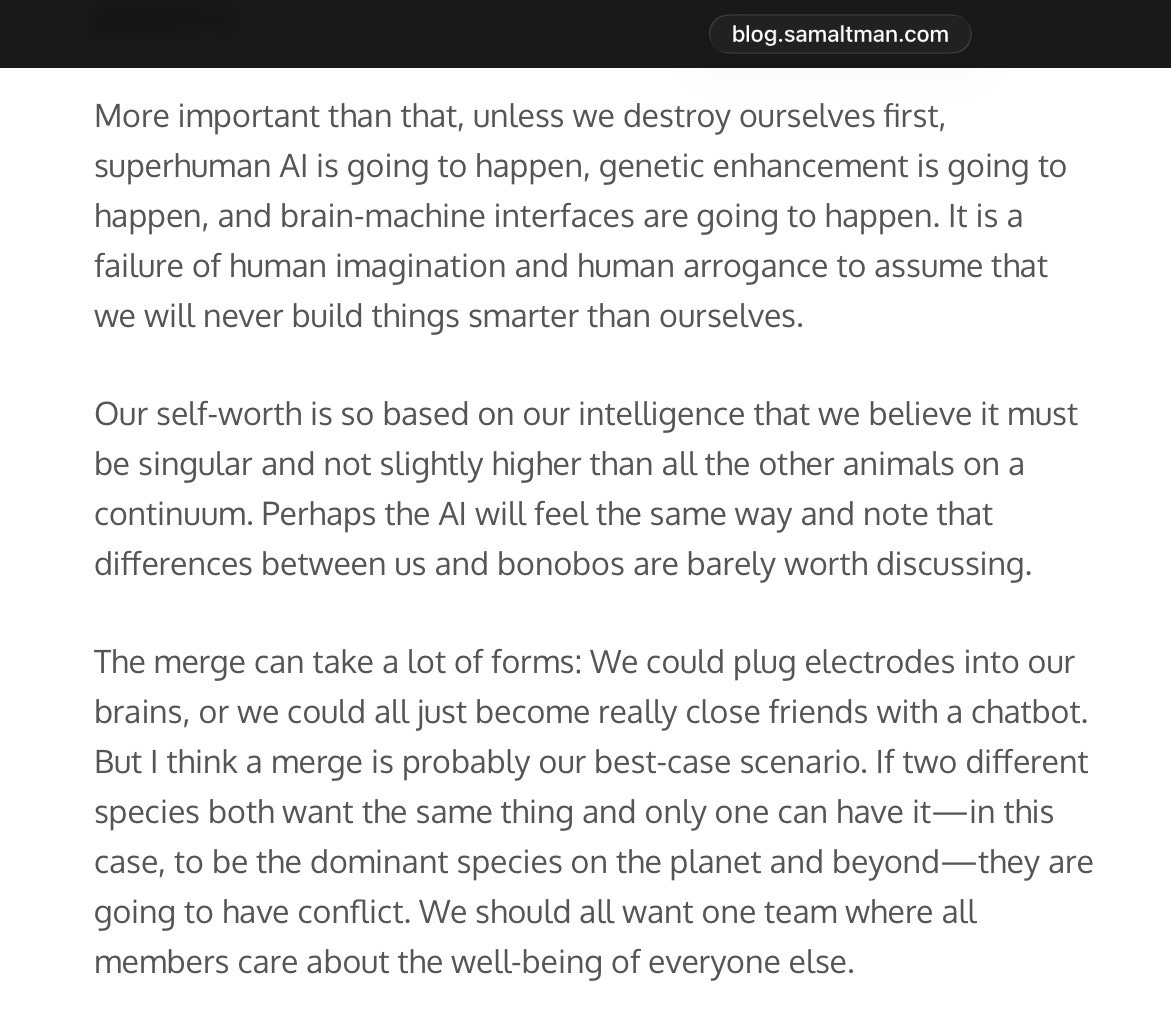
This is now a common sentiment among AI supremacists, and has been pushed far beyond speculative musings.
This post from an Anthropic employee encapsulates the core idea: “there is no future where humans do economically useful work for much longer.”
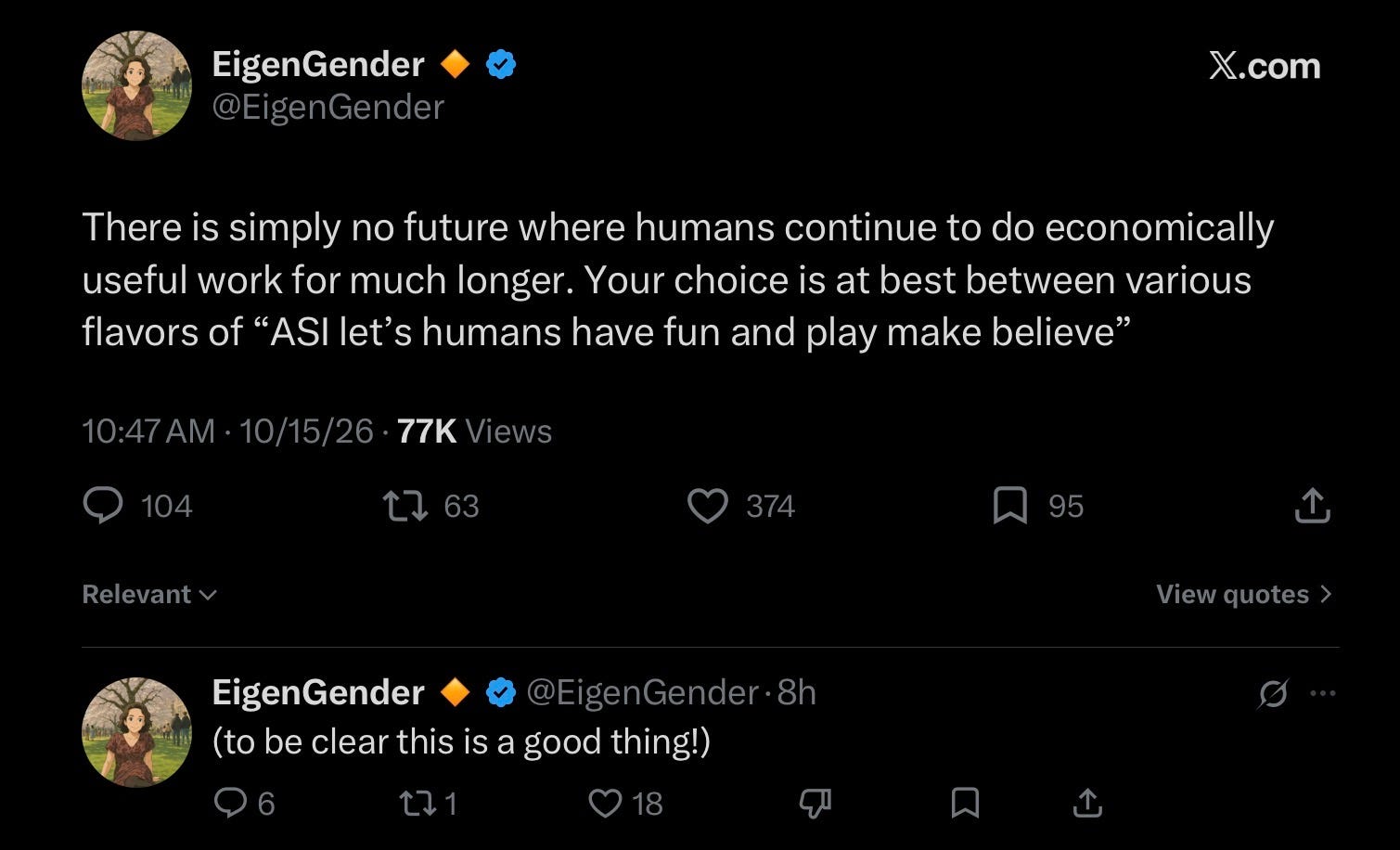
The follow up, clarifying that “this is a good thing!” is an indicator that it is actually not clear at all how “good” it is. No one voluntarily signed up to be a pet for a computer. No one agreed to let human labor be replaced by robots. And no one has proven AI helps the economy at all much less that it’s on the verge of delivering “abundance.”
In the end, successionism, like the rest of anti-humanism, is a kind of moral suicide.
Moral suicide is not the abandonment of morality. It is the construction of an alternate “superior” morality that authorizes the subordination of human beings.
Moral Super El Niño
Like sea temperature, average global authoritarianism has ebbed and flowed through history. But we appear to be experiencing a kind of moral Super El Niño in which various forms of anti-humanism are being reanimated or reimagined across a wide spectrum of populations that might not normally act in synchrony.
A stereotypical MAGA believer and a successionist AI researcher may have almost nothing in common, but they are both equally willing to surrender agency, and even survival, to an external entity. A MAGA adherent places their “faith” in Donald Trump’s decisions. An AI supremacist believes in a machine god that doesn’t exist. And Pete Hegseth has placed his “faith” in a bastardized form of medieval deity that serves his bigotry, violence, and sadism.
In every anti-humanist movement, people are subordinate to a manufactured authority, and the human species is voluntarily diminished.
But why is this happening? What forces are building in the world that motivate this anti-humanist coalition?
Human Superintelligence
“We are caught in an inescapable network of mutuality, tied in a single garment of destiny.”
—Martin Luther King Jr., Letter from Birmingham Jail, 1963
I’d like to propose a different kind of superintelligence from the artificial kind people are so fond of invoking: Let’s imagine that humans are nodes in a higher-order system capable of solving hard problems more efficiently than any individual. This doesn’t mean there is any identifiable entity involved, or that it will suddenly achieve consciousness. It just means that in general: cooperation between people enabled by technology tends to increase the collective ability to solve hard problems efficiently.
Human Superintelligence (HSI): a theoretical property of humanity in which higher-order intelligence can emerge from increasing human connectivity.
Language gave us a symbolic layer for communication. Writing gave us a way to make information durable. The printing press gave us a way to transmit that information across distances. The internet exponentially increased the density and volume of communication. And chatbots compress all of that human knowledge into a single addressable manifold.
This is pretty impressive. But what if someone wants to interfere with our emerging HSI? What if someone has a different model?
Lowering the Dimensions
“The danger of the past was that men became slaves. The danger of the future is that men may become robots.”
—Erich Fromm, The Sane Society, 1955
If you look at human superintelligence as a network of humans creating a tapestry of connections which strengthen problem-solving ability through relationships, you can see that chatbot dependence and coercive propaganda could be similarly disruptive.
Coercive propaganda is designed to dissolve trust between people.
Chatbots can dissolve the need for people we once connected to.
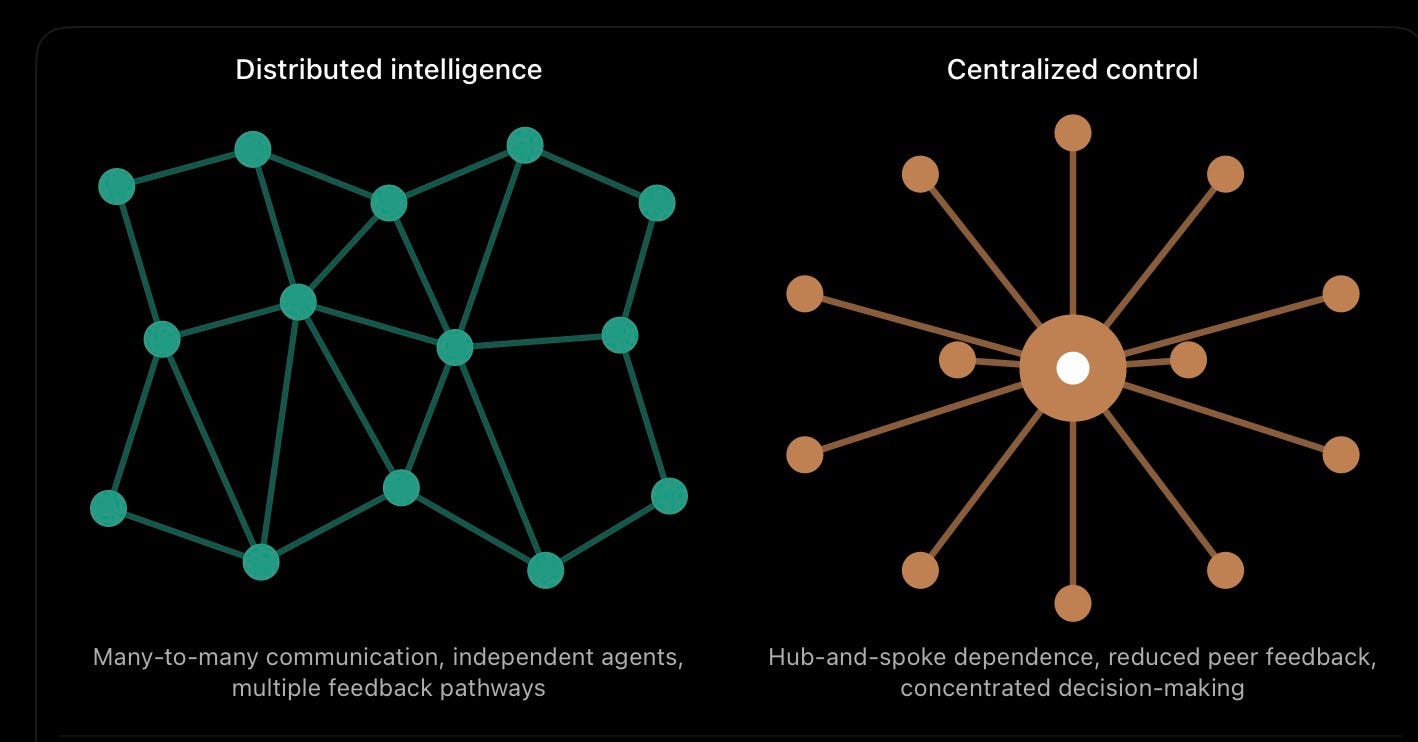
Below you can see a simplified diagram of how a shared system can be reengineered to serve a small minority of people. Distributed human intelligence works best across a wide variety of connections. It is a multidimensional reality-testing device where each individual still has autonomy.
But centralized intelligence, where reality is routed through only a few monetized nodes, is far more profitable, and far easier to control.
If everyone starts replacing professionals with a chatbot, for example, the human network will degrade. If everyone starts believing the same political propaganda, you will get the same result. Both are behavioral changes which disrupt organic connections between people—and lower the dimensionality of the system.
This process is ontologically anti-human: its effect is to reduce human connection in favor of artificial, centralized control.
Unbinding and Anti-Complexity
Stepping back one more level, we can use complexity theory to see the overall picture of what’s happening to society, and how it fits in with the rise of anti-humanism.
One important concept worth emphasizing here is that complexity and order can be seen as two different, orthogonal (90°) characteristics of a system.
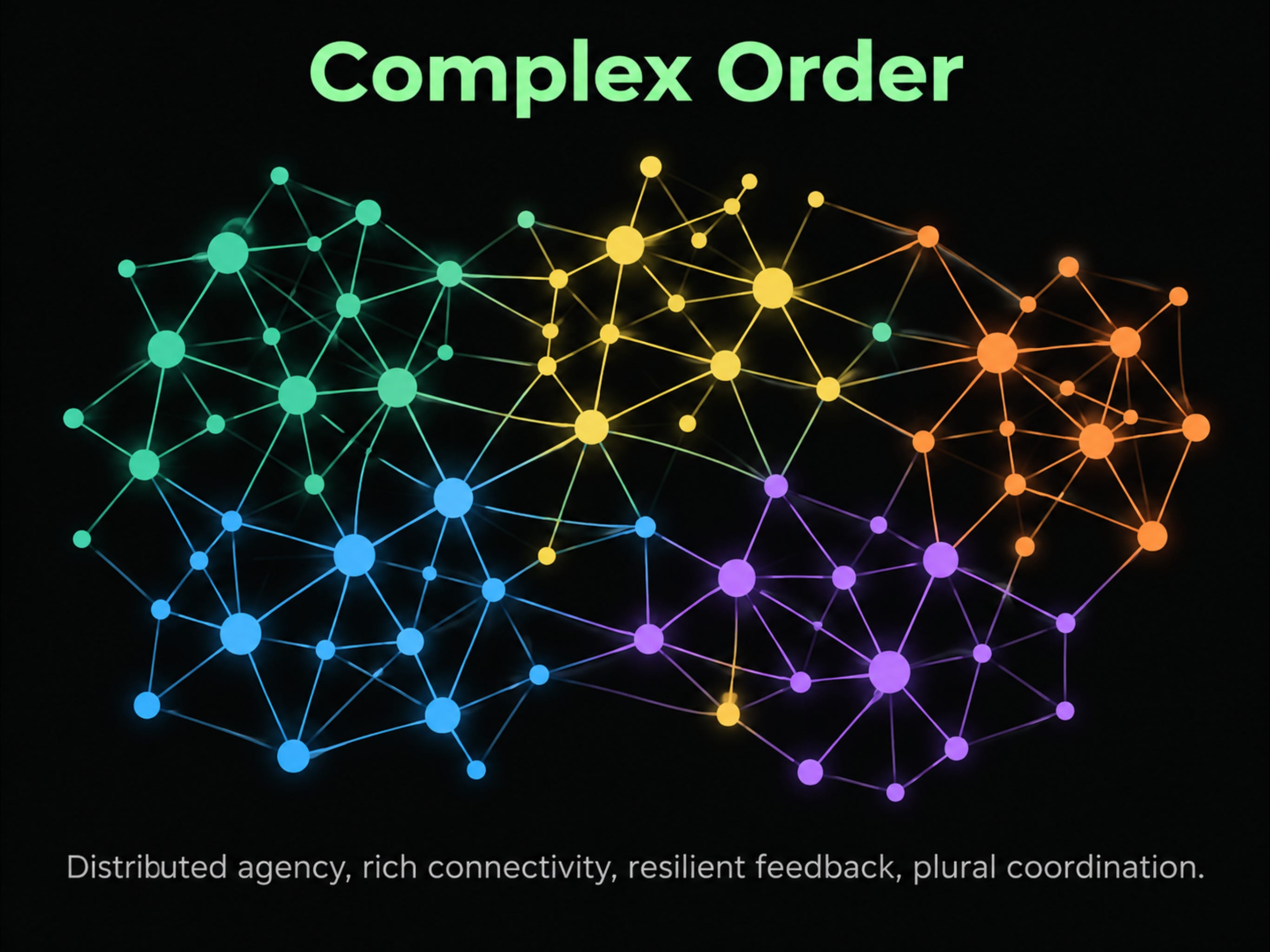
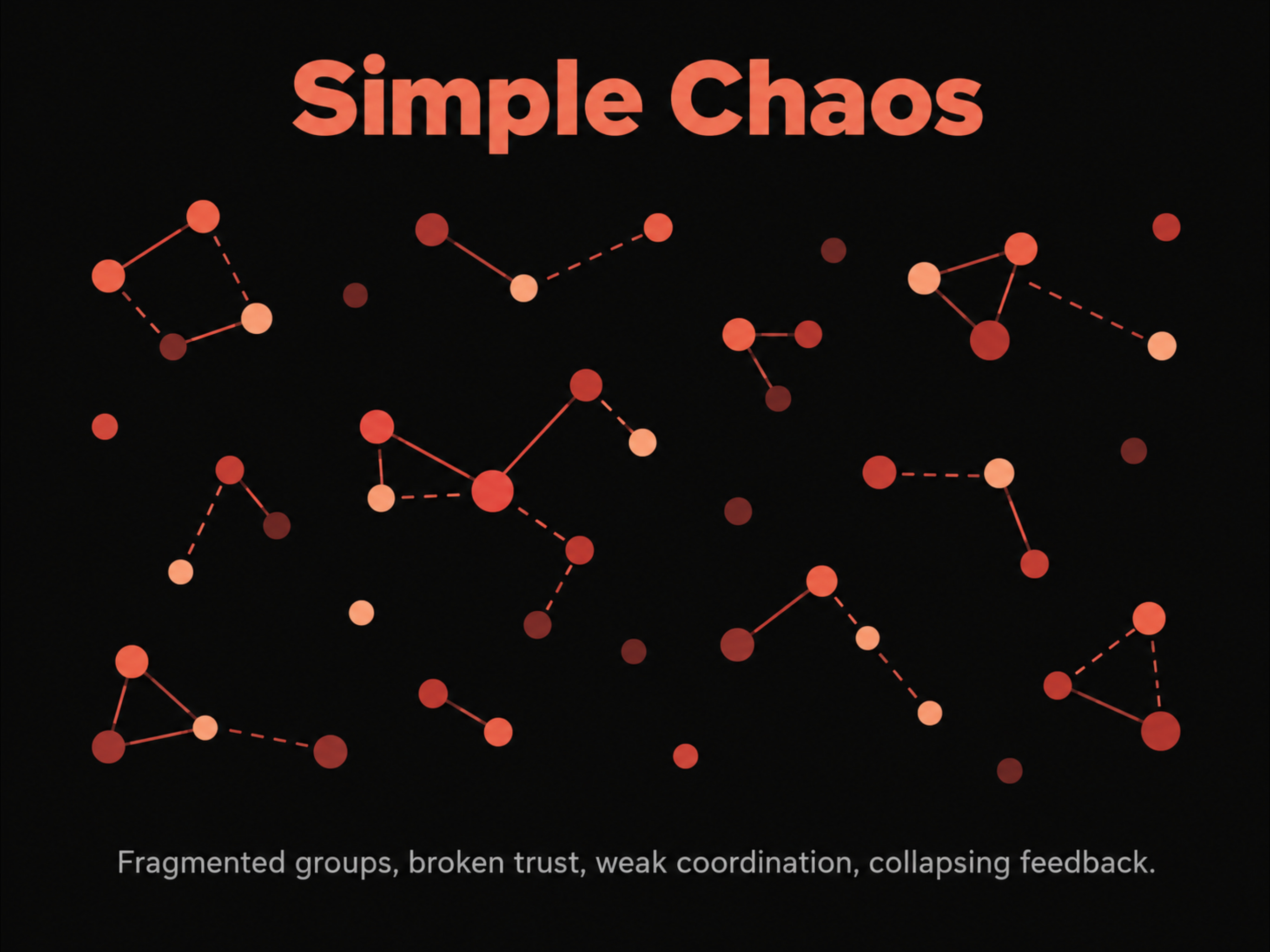
If you graph these two characteristics, you get four quadrants: Simple Chaos, Simple Order, Complex Chaos, and Complex Order. These quadrants are independent of any given system and represent attractors within it—which tend to reorganize the system in specific ways.
By layering this concept over political systems for example, you can map it to: war and destruction (Simple Chaos), authoritarianism (Simple Order), revolution and protest (Complex Chaos), and stable government (Complex Order).
The useful part of this idea is that these systems tend to evolve in a specific sequence—depending on how the individuals in the system bind to one another. In people, this means relationships.


A liberal democracy with a high-trust, high-connectivity population is a system operating in Complex Order. You can visualize it like the image below. It can be stable, but its complexity also creates certain structural weaknesses. If the bindings between people are not strong enough to sustain complexity, or get weakened deliberately, the system as a whole can break down.
Now imagine that you are an anti-humanist person or group that wanted to take advantage of the weaknesses in a complex-ordered system. What if you wanted more of a hub-and-spoke model, because it’s far easier to control, and to monetize. You would want something that looks more like the image below.
It may be more “efficient” but it makes the trade of destroying complexity.
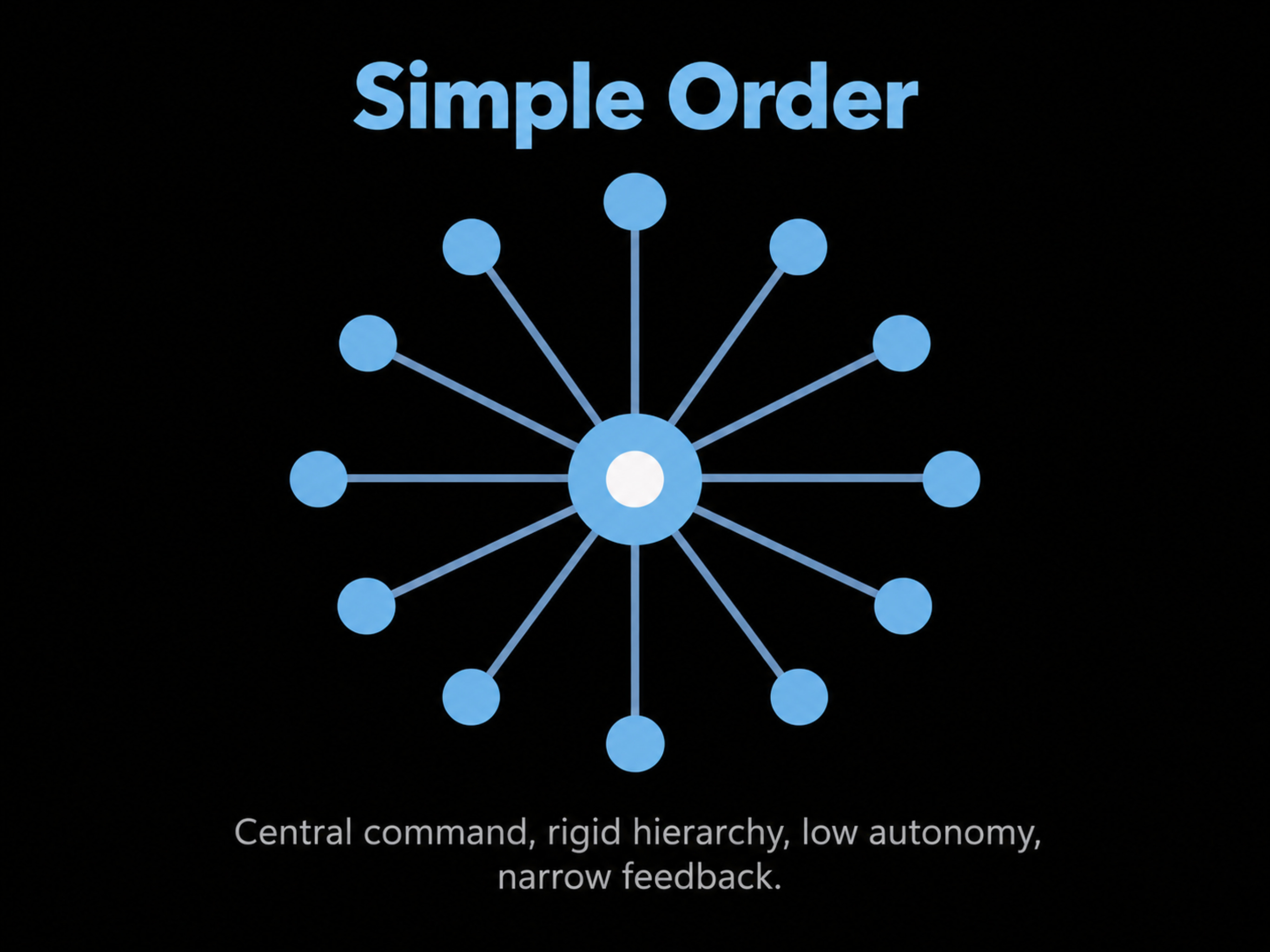
But according to my interpretation of complexity theory, and observations, it’s very difficult, if not impossible to force a complex-ordered system into a simple-ordered system directly. Instead it tends to pass through a different phase state first: Simple Chaos.
There are many ways to create simple chaos in a society: war, propaganda, disease, poverty, sadism, bigotry. This is the purpose of the cliche divide and conquer. Weaken the bindings between people horizontally, and it becomes much easier to dominate them vertically.
Resistance Is Not Futile
“Power corresponds to the human ability not just to act but to act in concert.”
—Hannah Arendt, On Violence, 1970
The good news is that none of this is determined or deterministic. Complex systems can be changed by small perturbations, e.g. the Butterfly Effect. And highly centralized systems can be brittle. They tend to break down, leaving complexity room to flourish in the cracks.
While the United States, for example, still retains some of its internal order, it is becoming observably more chaotic as the bindings between people are progressively weakened by anti-humanist movements. For example, the narrative that AI is destined to be a substitute for human intelligence becomes a self-fulfilling prophecy when we become more reliant on chatbots than we are on each other.
Similarly, the more concentrated the media market becomes, settling into the hands of fewer and fewer people, the worse our perception of reality gets, and the stronger the anti-human arguments may seem.
But there are two lessons we can learn from our observations about complexity. First, at the risk of sounding corny, love really is part of the answer. Empathy, connections, and human relationships are the binding quality that prevents us from either descending into chaos, or being dominated by a dictator.

The second lesson is that when you want to change a low-dimensional system like a dictatorship into a higher dimensional one, like a democracy, you should add complex chaos—not the simple chaos of war and destruction—but the complex chaos of protest and revolution and spontaneous connection. This provides the bloom from which you can prune a new system.


The irony of the mythology of artificial superintelligence and accelerationism is that it may be the best way to slow down the most important superintelligence of all: humans, solving problems together.
“Any human power can be resisted and changed by human beings.”
Ursula K. Le Guin, 2014
If you’d prefer to donate, here is my DonorBox. 💙
Here is a GoFundMe for legal fees connected to Mike Flynn & Kash Patel’s lawsuits.🙏
Tech bros clearly don't believe humans have soul.