

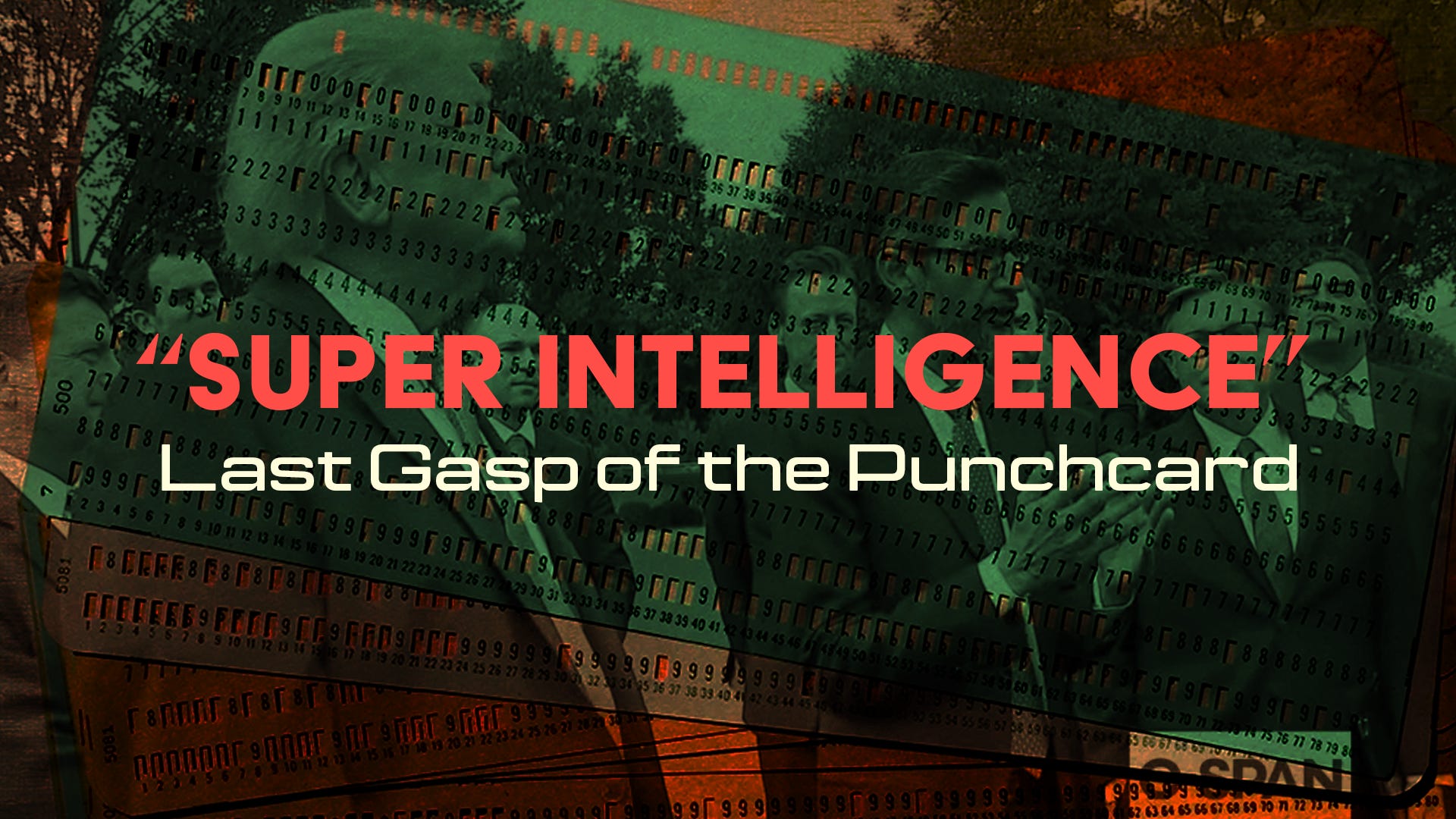
I am increasingly certain that the AI industry, the billionaire class, and the Trump regime are driving America into a $10 trillion ditch—although it may not get that far before the economy collapses. To understand why this is happening, you need some background on the industry, a view on the incentives that have distorted it, and a clear sense for how the current technology stack is doomed to fail.
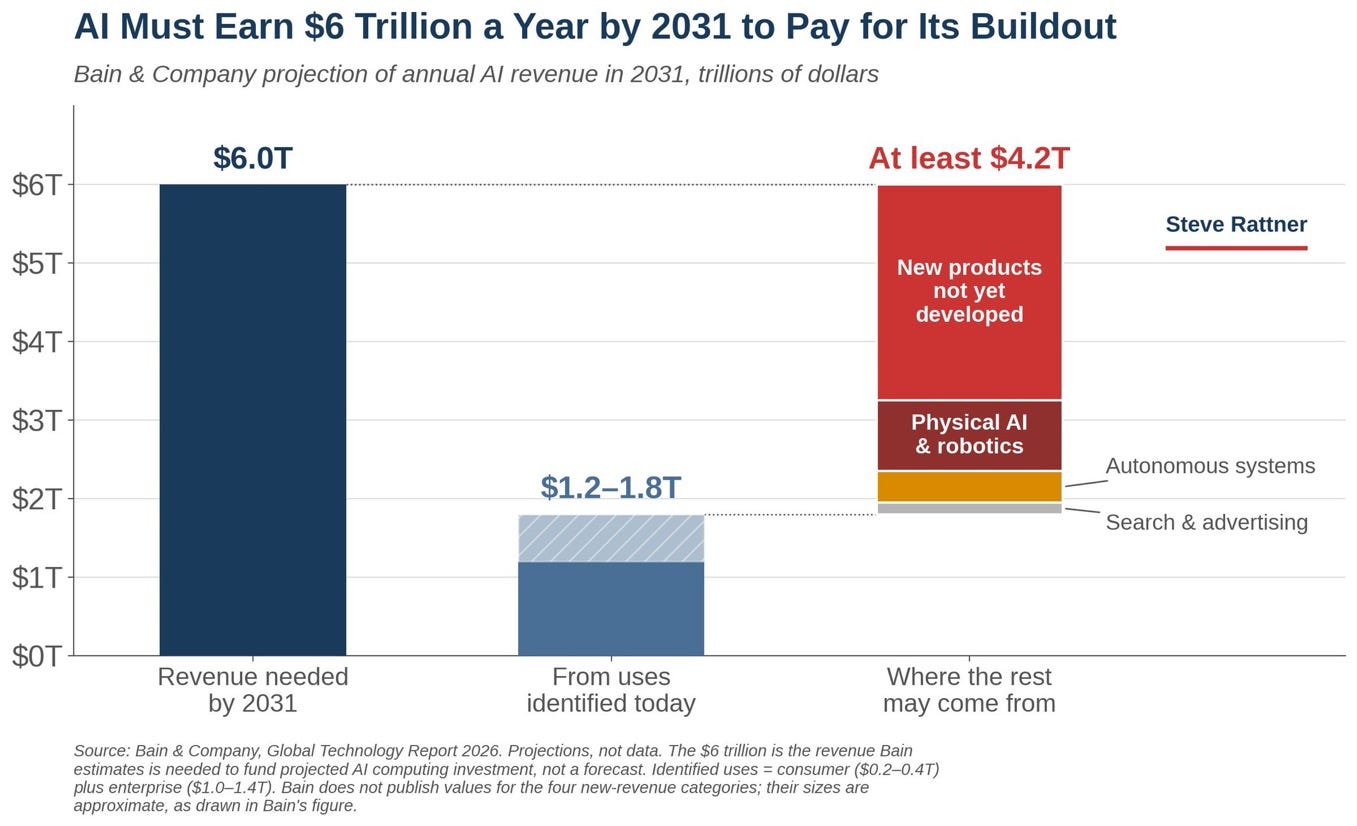
First, in order to get a sense for scale: Were the industry able to meet its full objectives for physical buildout of data centers, it would require $6 trillion per year in revenue by 2031 to pay for itself. Most of that revenue has not even been identified yet by product category. It is purely speculation.
Where on Earth is all that money supposed to come from?
Punchcards
As the only child of a government programmer in the 1970s, my mom would occasionally take me to work if school was out and she had no child care. This would leave me with 8 or 9 hours to kill in the offices of the Small Business Administration, or the Bureau of Prisons. While that may sound like torture to a kid, it beat school by a mile.
One of the things in the office I would play with were punchcards. There were huge stacks of them. It’s how I learned to shuffle.
Up until about five decades ago, that’s how memory was stored for tabulators to process. Each card was a physical record, of a person, a crime, a transaction, etc. and some additional information—all encoded in little holes. You’d feed them into a machine—which would get jammed half the time—for processing.

Today, the equivalent function, physically storing memory in a digitized form and moving it to another place for processing, then moving it back, has been scaled up to data center size. But instead of humans hauling around massive stacks of cardboard, the process has been shrunk to a microscopic level and replicated millions of times on GPUs—a market now led for many years by NVIDIA and its CEO Jensen Huang.
But the core problem remains. It’s a lot of work to move information from one place to another. This is the dirty secret of the AI industry. They still rely on this basic, incredibly inefficient model.
Transformers, But Not Giant Robots
Without getting too far into the details, the entire chatbot industry as it exists today was born from an important discovery in 2017—the transformer architecture. While text generators like the predictive text on your phone had already been developed, when someone figured out a much more efficient algorithm to figure out the likely next word in a sequence, it became a race to see who could exploit it first—and fastest.
It turned out that transformers could be broken up into different parallel operations which work really well on GPUs like NVIDIA’s.


While transformers did not inherently improve the accuracy, or “intelligence” of the core algorithm, it did make things much, much faster to process.
This led to GPT, Generative Pre-trained Transformer, which describes its own limitations quite well. It only generates content, based on pre-training, using a specific method of predicting text—the transformer.
To be fair to the AI industry, they have shown that you can combine enormous amounts of energy with the stolen works of all humanity to produce convincing holographic postcards from our own exhaust. What you can’t get from it, however, is real intelligence.
The primary reason for this is the core architecture of GPUs, which essentially remain like a lot of little punch cards. You still have to move stored physical memory to a processor, do a lot of math on it, and move it back to memory. The bottleneck is not the processing; it’s the data transfer.
Von Neumann
Now, those little punch cards can do a lot of work. For example, I used ChatGPT Sol 5.6 High to produce this chart.
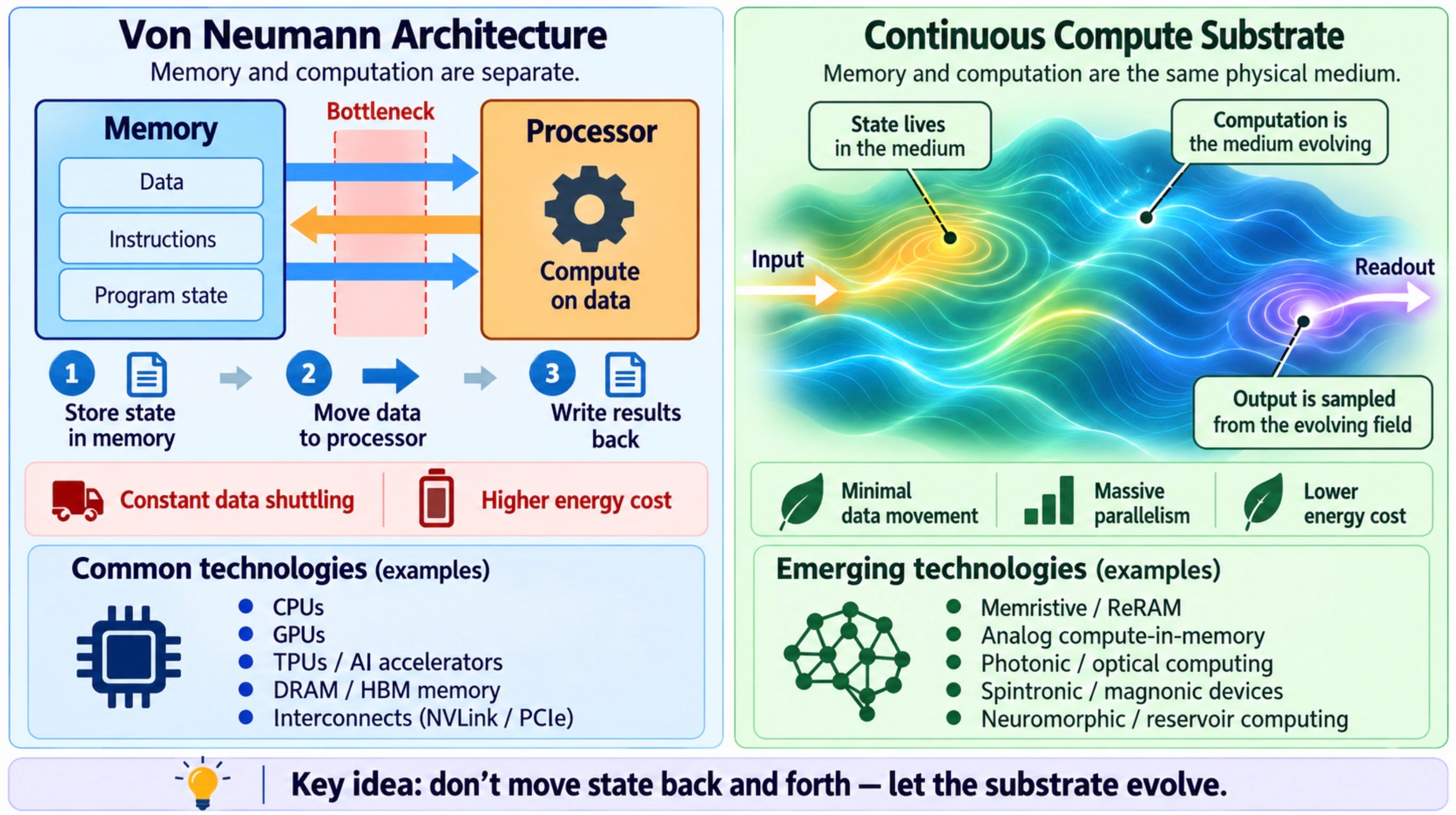
The Von Neumann architecture is how most general purpose computer chips work. It deliberately separates memory from the processor. Both CPUs and GPUs use it.
But the physical limits of this architecture are being challenged. Performance is less about the processing and more about moving more data. Up to 90% of the energy in modern data centers is used shuttling bits around rather than doing computation.
If it weren’t for the Von Neumann bottleneck, there would be no need for such enormous data centers.
Not only is keeping memory and computation separate at this scale extremely inefficient, it is not how brains work.
A neuron does not take in information, convert it to digital form, send it off to a simulation of a brain, and receive the answer back when it’s done. The physics of the neuron is the computation. It receives a signal and changes based on how the combination of its existing state and the new stimulus alters its physical properties. A neuron doesn’t “calculate,” it allows the universe to do it using physics.
This is not unknown to the industry. There are a significant number of companies and researchers working on different forms of memory which combine storage and computation. These include memristive, photonic, and neuromorphic chips which do not require the kind of data transfer of GPUs because the memory and the processor are physically the same.
20 Watts
To get a sense for how much room there is to improve on AI technology, the human brain uses as much energy as the 20W LED lightbulb below. The average new datacenter requires power measured in the hundreds of megawatts to gigawatts—7 or 8 orders of magnitude more. And it’s still ultimately just recycling things we’ve already done.


As someone who worked in technology for 35 years, including many projects working with AI at various points, I assure you that enormous energy-sucking data centers are not the future of AI. Technological innovation that relies purely on scale is destined to reach a physical limit. We’re watching it happen.
So why is the industry still barreling ahead? Cui bono? Silicon Valley billionaires, banks, the oil and gas industry, the stock market, and the Trump regime.
Right now AI spending between 2025 and 2032 is estimated to gobble up more than the average growth of the entire country—at 3.6% of GDP. The only comparable booms (and busts) left permanent infrastructure like railroads and fiber which combined didn’t match the scale of data center buildouts.
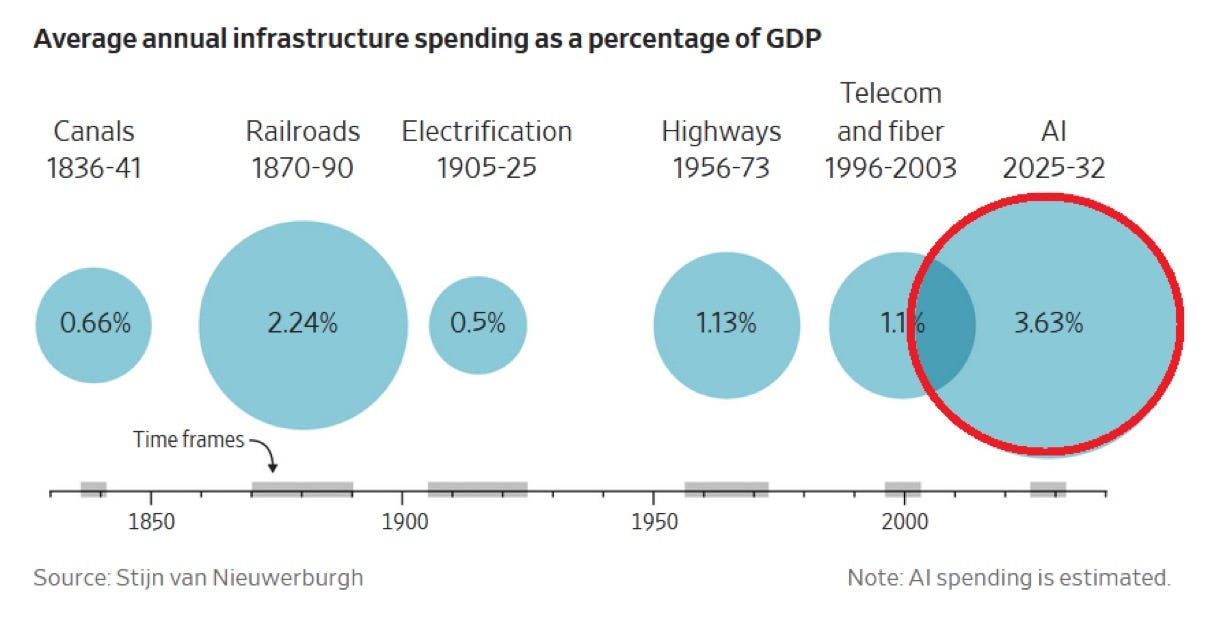
But AI in its current form does not leave permanent technology infrastructure that remotely covers its cost. Most of the money is being used to build what Jensen Huang of NVIDIA has branded “AI factories” which he says are a “complete reinvention of the computing stack.”
Au contraire. The problem is they haven’t reinvented anything at all. What they’re good at inventing are new ways to justify their massive data center buildout.
Elon Musk’s big idea is to make AI even more expensive and implausible by launching data centers on rockets into space—truly one of the most absurd ideas ever uttered with a straight face. Musk and Huang also agree “every 1GW of compute equals another 1% of GDP” with absolutely no rationale or evidence. It’s all just sheer made up nonsense, from two men responsible for companies worth over $10 trillion.
The “factories” Huang talks about are not the big ticket item. It’s the GPUs, the million dollar racks inside the data centers, the specialized equipment, and the energy required to cool and run them that costs most of the money.
Crucially, these chips don’t age like railroad tracks. Whether the chips live on Earth or in orbit, in Tennessee or Michigan, they age more like milk. NVIDIA’s schedule ships faster chips every year, ensuring every product that came before it is made more and more obsolete. Most technology companies start depreciating GPUs after just two years and completely write them off within 5-6 years. The data centers don’t get better as new technology arrives; they get worse until you have to replace them.
That’s not infrastructure. That’s a short term bet that magic is going to happen.
They Never Learn
Perhaps the most glaring technical problem with the current generation of AI is that it is a static technology. That is, a chatbot doesn’t learn. It doesn’t remember you—or anything it does. It can’t gain real experience.
While you can bolt on some temporary memory to a static chatbot as they currently do, the core model cannot change until another version is trained and launched. The model never learns, not until the next version replaces it.
The chart below is a comparison of the way the current AI models improve through scaling larger, and a different architecture based on technologies that are either in existence or currently in development that would learn—and wouldn’t take such massive data centers to run.
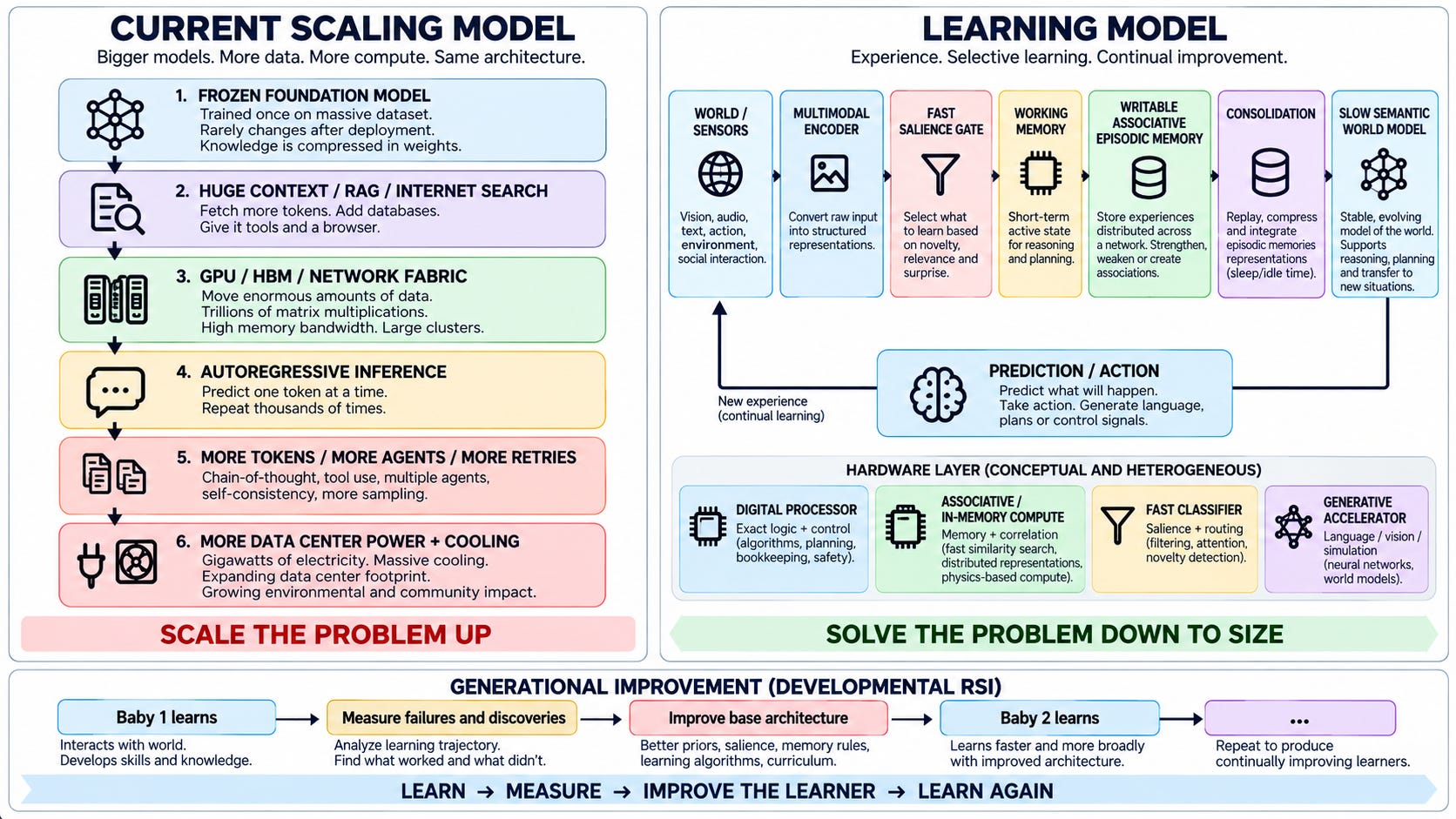
Essentially every part of the “reinvention of the computing stack” that Jensen Huang and the AI industry is committing trillions to build is destined to be updated and replaced in the not distant future. There is not only no “moat” within the industry; the industry itself is extremely vulnerable to any improvement that comes from outside its insulated group.
Were a true learning system to be developed at commercial scale, at a lower energy footprint than GPUs, the entire AI industry could collapse in short order, leaving trillions of dollars of investment stranded.
Super Duper Intelligence
For several years, according to CEOs at “Magnificent Seven” companies like Microsoft, Amazon, Google, and Meta—the reason they have collectively invested trillions into GPUs is they feel they cannot afford to “lose the race” to reach the ill-defined goal of artificial general intelligence (AGI) or artificial superintelligence (ASI).
It is this golden goose they crave, these magic beans, not the current generation of chatbots as a final goal. But this obsession has progressed to the point that the CEOs of multi-trillion-dollar companies will grovel and scrape to a mentally ill president, allowing him to change the name of their own technology—a name that’s been around for nearly a century—by government fiat.
On Tuesday, the U.S. government prohibited itself from acknowledging “artificial intelligence” or “AI” at all. It must now be referred to as “Super Intelligence” only.
It is therefore the policy of my Administration that, to the maximum extent permitted by law, the executive branch shall use the terms “Super Intelligence” and “SI” in place of “Artificial Intelligence” and “AI” and will not acknowledge the usage of “Artificial Intelligence” and “AI” in any applicable setting.
—INAUGURATING THE ERA OF SUPER INTELLIGENCE, Executive Order 9/29/26
The same day at the White House, the heads of Google, NVIDIA, SpaceX, Anthropic, OpenAI, and Meta signed a separate letter that promises the industry will, according to Trump, “be policing each other.”
Sure, Jan.
As GOP Senator Rick Scott admitted:
“Congress can’t regulate this. We can’t get election security passed or pass a budget, so we’re not gonna be the ones to do it. It’s gonna have to be done through the administration with talking to these AI companies.”
Donald Trump has effectively disabled Congress, seized control of the largest industry in America, exempted it from regulation, and unilaterally rebranded it so he can keep the stock market bubble going. It is absolutely extraordinary.
OK, But Is It Going to Kill Us?
To understand how deeply unserious and deceptive this industry is, you simply need to watch CEOs like Dario Amodei—who just last week was warning everyone of a chatbot extinction event—and notice he has nothing to say when Trump dismisses everything he claimed.
Either he was lying then, or he’s being murderously irresponsible now—for allowing such an allegedly dangerous technology to be developed with no guardrails.

I will assert again, with even more conviction: The chance of the current technology stack rising up to “kill all humans” is precisely 0.0%.
But if we do not figure out a way to stop this industry from carpeting the planet with inefficient, energy hungry data centers that replicate punchcards millions of times over, the chance of an economic winter approaches 100%.
Or if you’d prefer to donate, here is my DonorBox. 💙
Here is a GoFundMe for legal fees connected to Mike Flynn and Kash Patel’s lawsuits.
Thanks for your support. 🙏