

“I believe in an America where separation of church and state is absolute—where no Catholic prelate would tell the President how to act and no Protestant minister would tell his parishioners for whom to vote”
—JFK, to Southern Baptist leaders, 1960
“Religious Liberty”
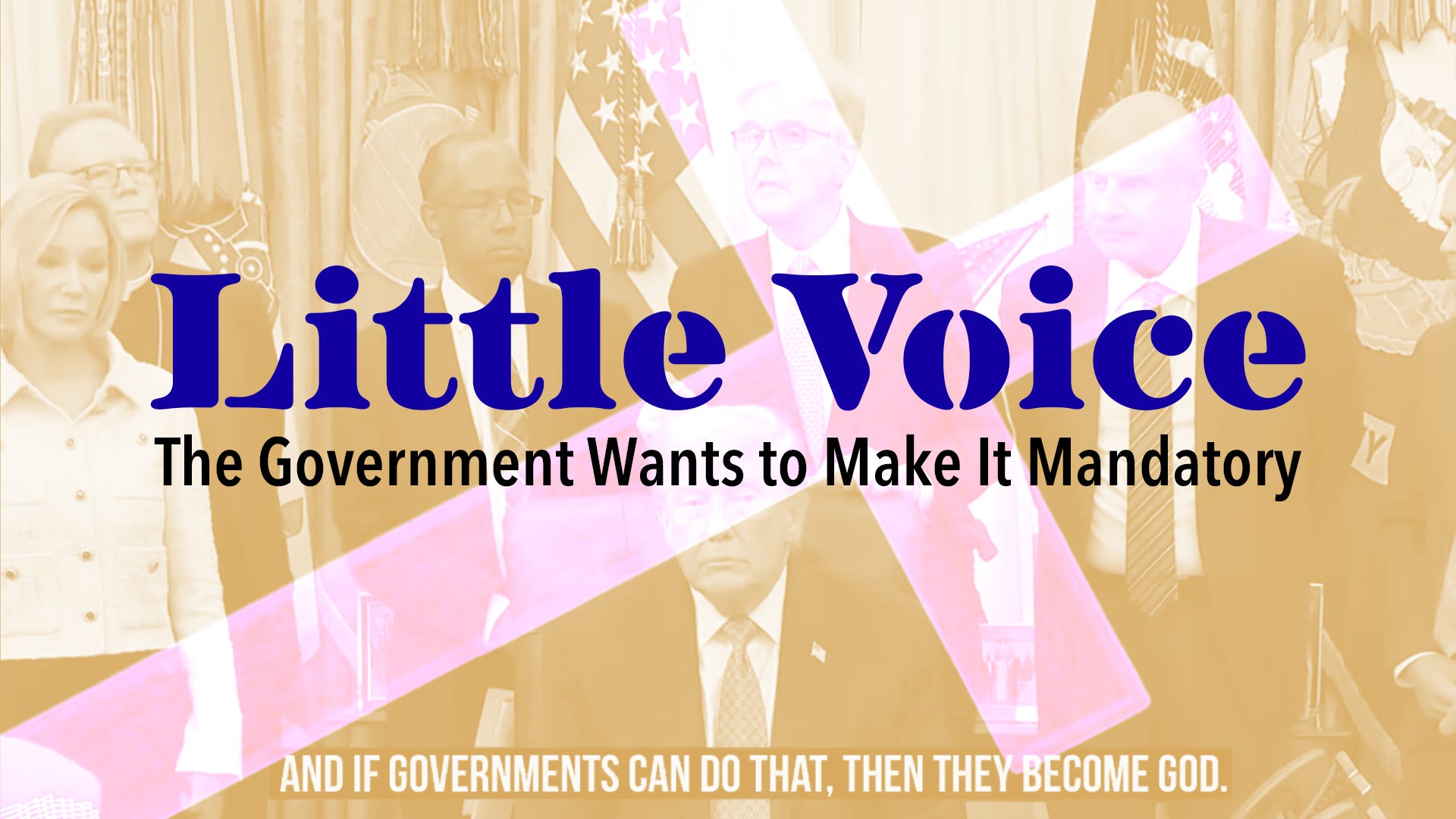
In the White House Friday, standing behind a somnolent president, Texas Lt. Governor Dan Patrick made a startling pronouncement:
“The key is… one phrase, that’s not in the Constitution, and that phrase is separation of church and state. The left has used that one phrase that was one line out of hundreds of letters by Thomas Jefferson to batter and hammer people of faith for the last 70 to 80 years. And this report will speak very clearly that we want to be sure Americans understand that they cannot be attacked by that phrase any longer.”
Patrick is the chair of the Presidential Religious Liberty Commission, a White House office directed by the Justice Department, which delivered Trump a report on alleged incidents of people being persecuted for their beliefs. It offers a series of conclusions and actions which will supposedly ensure “religious liberty.”
In reality, it is 220 pages of some of the weirdest and most insidious propaganda I’ve ever seen, especially from a government.


Little Voice
In his White House comments, Dan Patrick defined “religious liberty” this way:
“The question is what is religious liberty? It’s our conscience. It’s that little voice inside of us that tells us right from wrong. It’s that voice that when we’re in trouble we can talk to in our quiet moments. It’s that voice that we feel unloved and alone that can comfort us through a higher power.”
Dan Patrick’s “little voice” is very powerful apparently. It is at least three things: a moral conscience, a way to frame self-talk, and an emotional regulator. It covers most of human inner experience—all in the form of a “higher power.”
But that is not “liberty.” That is a private interior realm that has nothing to do with me or you, dear reader. To equate it with freedom is just an abuse of language to transform a personal belief into a legal weapon. Nevertheless, it starts a chain of twisted logic that ends in ripping up the Constitution:
“When governments can take away your religious liberty, they’re putting their hand in your heart and taking everything you believe in. And if governments can do that, then they become God. The president spoke earlier today at the Communist threat in this country. We know what communists do around the world. They remove God. They close the churches. They punish the believers.”
Dan Patrick is saying that somehow the government can “take away” your “little voice” without ever explaining how or why it would do that, or what happens if you don’t have one. But what he really means is that anyone who doesn’t share his ideology is a godless “communist threat.” It follows from this line of thinking that everyone must be forced to obtain the little voice through government intervention.
Required Reading
This is no idle talk. On the same day the report was delivered, in Dan Patrick’s own state, Bible stories became required reading in Texas. His little voice is becoming mandatory.

Separation of church and state is not just an interpretation of the Constitution. And it is not a liberal myth. It is bedrock to the entire American project—and has been from the beginning. “God” does not arise in the Constitution, and the only time it’s mentioned in the Declaration of Independence is as “Nature’s God,” a deliberately non-Christian, deist, Enlightenment-era formulation.
To make it as clear as possible, the founders chose to make the first ten words of the Bill of Rights the Establishment Clause: “Congress shall make no law respecting an establishment of religion.”
In 1796, the government of George Washington started to negotiate the Treaty of Tripoli, which was ratified by Congress and signed by John Adams in 1797. In order to reassure potential partners who had been the targets of Christian colonialism, the document read in part: “the Government of the United States of America is not, in any sense, founded upon the Christian religion.”
In 1875, President Ulysses S. Grant said:
“Leave the matter of religion to the family circle, the church, and the private school, supported entirely by private contribution. Keep the Church and State forever separate.”
—Address to the Army of the Tennessee, Des Moines, September 29, 1875
You can find reaffirmation of this basic tenet of government throughout American history because it was one of the most important pillars of the Enlightenment, which inspired the founders and provided the basic architecture for the Constitution.
The Existentialists Did It
Despite the facts of America’s founding, in a truly ignorant, ahistorical passage, the Religious Liberty Commission report asserts separation of church and state is a kind of 20th century mythological construct caused by the influence of European existentialists. Three in particular I’ve written about: Nietzsche, Michel Foucault, and Sartre.
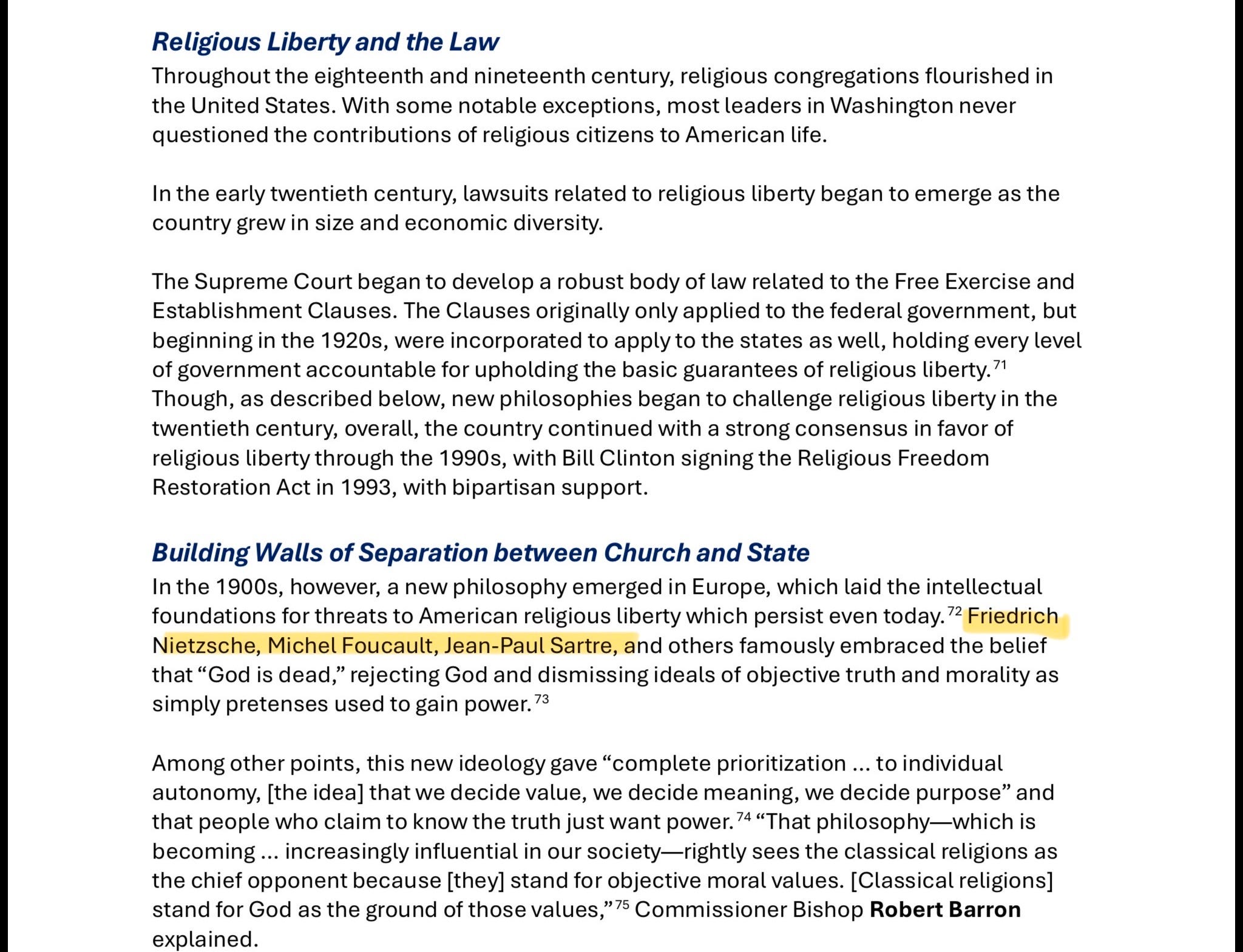
While a full philosophical rebuttal to this reductive illogical nonsense would take a book, generally speaking the mere presence of the report itself, along with its theocratic recommendations, provides a perfect example of what each of these thinkers feared most.
Nietzsche’s “God is dead” was not a celebration of the decline of religion. He was not a nihilist. He saw the Enlightenment as a substitute for God, which he thought was a catastrophe. He believed destroying the foundation of religion—the belief in God—through science and reason while retaining its morality was a fundamental error.
He would have seen the Commission’s report as what he called ressentiment—outrage at the perceived cause of one’s persistent frustration.

Michel Foucault was deeply interested in the use of “regimes of truth” by institutions like religions and governments—which define reality in whatever way serves their purpose. The actions recommended by the report would set up a kind of Christian panopticon, which Foucault saw as a method to make the population feel watched at all times, whether they really are or not.

Sartre would have seen the report as a quintessential artifact of what he called mauvais foi—bad faith—lying to yourself to be relieved of the anxiety of choice.
“I attempt to evade the anguish of my own freedom by making myself a fixed role, by being something rather than someone—and that is bad faith.”
—Existentialism Is a Humanism, Jean‐Paul Sartre (1946)

The caricature offered by the Commission’s report of three of the most important thinkers of the 19th and 20th centuries as subversive anti-American influences says far more about the authors than about their targets.
Nightmare
In the first Trump administration, you might dismiss this report as propaganda, and see the recommendations as merely performative. But this is a different group with an unhinged, unrestricted president, and they want to do real damage. When seven people who committed no violence are condemned to 450 combined years in prison for being in “Antifa,” you have to believe the regime is capable of following through on its threats.

Here are some of the report’s recommendations:
Redefine church–state separation through DOJ guidance.
Create federal hotlines, portals, and reporting systems for alleged religious-liberty violations.
Expand litigation and funding penalties against noncompliant schools and institutions.
Promote “school choice” and stronger parental control over curriculum, gender, and healthcare.
Broaden religious expression rights in public schools.
Expand conscience exemptions in healthcare and the military.
Restore benefits lost over COVID-vaccine refusals.
Repeal the Johnson Amendment.
Increase enforcement against private employers and alleged religious “debanking.”
Intensify “anti-Semitism investigations” and funding sanctions, targeted at liberal schools.
Appoint judges committed to aggressive religious-liberty rulings.
Create official medals for religious-liberty “heroes.”
This does not create an environment for “religious liberty.” It institutionalizes a Christian worldview—and punishes non-believers.
America was created under the proposition that everyone should be entitled to their “little voice” if their religion gives it to them; and that everyone should be entitled to not have a secret friend that determines their morality if that works for them.
To have the government decide that its people must have a little voice in their heads is the nightmare the founders built America to prevent. It is mind control through altered reality.
For me, and for my grandchildren, it is the hill I am willing to die on.
If you haven’t upgraded to a paid subscription, please consider it! I never hide important information behind a paywall, so I rely on my readers for support. Thank you for reading and sharing!
If you’d like to help me with expenses, here is my DonorBox. 💙
Here are a few benefits to upgrading:
Live Zoom call each Sunday
Ability to comment and access all content
Wonderful, supportive community
Helping independent journalism fill in the gaps for our failing media
If you’d like to help with my legal fees: DefendSpeechNow.org.
Bluesky 🦋: jim-stewartson
Threads: jimstewartson
Thank you, Jim. This is confirmation that the Trump regime is fighting us: We the People, on every level of our Constitutional freedoms and Human Rights. Their stated vision of a Gilded Age is turning into an American Medieval Inquisition.
Debauched deranged hypocrites trying to impose a theocracy. Sick through and through and not in the least bit decent or Christian in my opinion.