

“What is permanent in the history of mankind is not the symbols but man himself in search of his humanity and its order.“
—Eric Voegelin, Equivalents of Experience and Symbolization
Hegseth’s MadLibs
On Wednesday at a prayer meeting in the Pentagon, Pete Hegseth led a roomful of American commanders and soldiers in prayer that he claims is used by A-10 Warthog pilots. He said it was based on a specific Bible verse, Ezekiel 25:17, but there was a serious problem with this claim.
Hegseth’s prayer had almost no connection to the Bible verse he cited. Instead, it turns out the prayer was actually Samuel L. Jackson’s terrifying monologue in Pulp Fiction (1994) with a few slight changes.
Hegseth was preaching in the Pentagon through Hollywood MadLibs, not biblical scripture. Below is a comparison of the three texts in question.
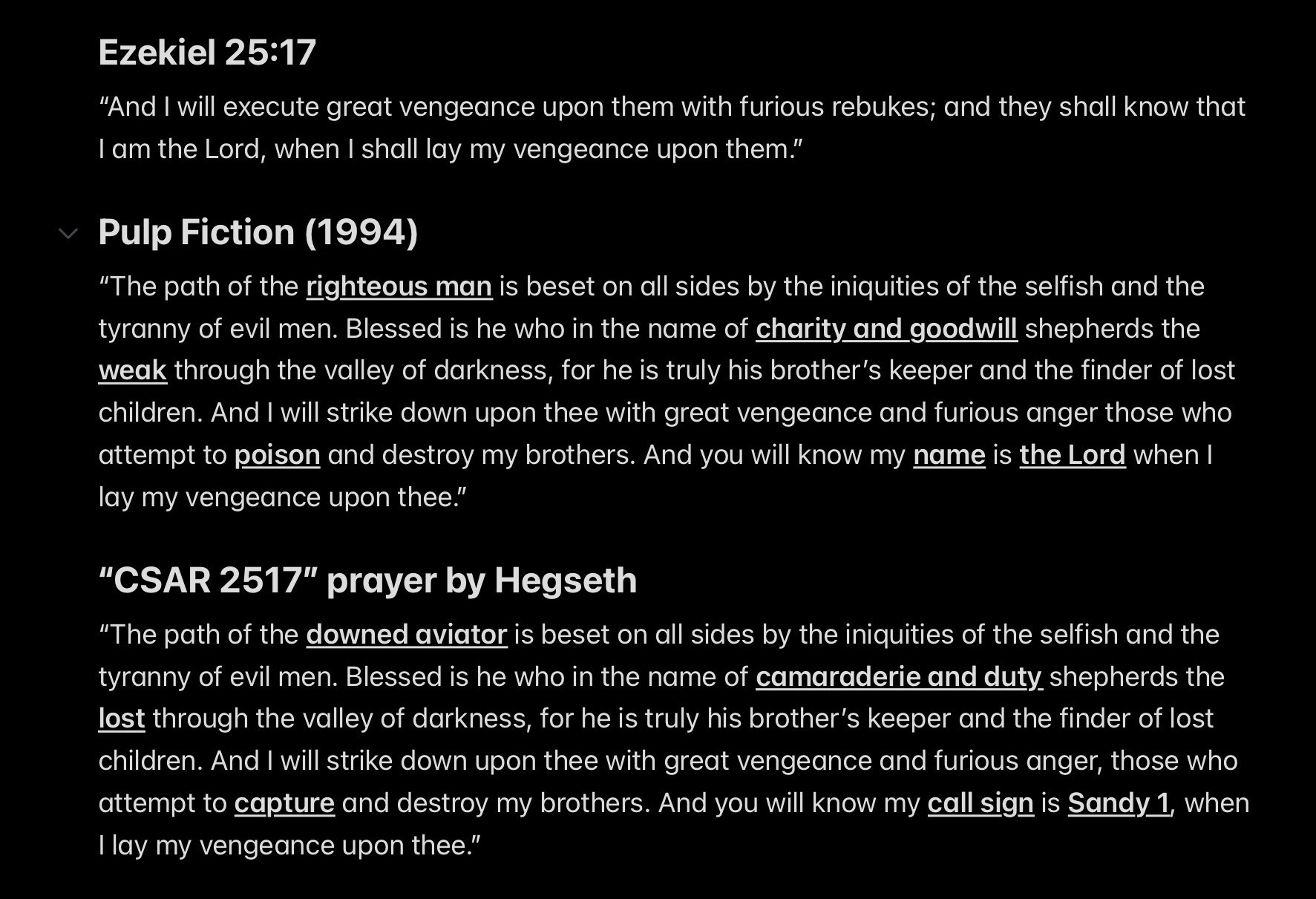
This is a vivid example of what I’m calling symbolic kidnapping, or in broader terms, semiotic sabotage—the misappropriation of the meaning of symbols and signs.
Semiotics is the study of signs. It is an interdisciplinary field that examines what signs are, how they form sign systems, and how individuals use them to communicate meaning.
In this case, Hegseth is doing several things at once. First, he is kidnapping the Bible’s authority and smuggling its symbols into a meme war celebrating extreme violence. He is redefining the contents of the most well-known book on Earth to match his own macho alternate reality.
Second, the entire purpose of the monologue in the film was to show how faux-theology can be used as an accelerant by amoral men to rationalize violence and murder. Hegseth is recasting a brutal commentary about the artificiality of his own beliefs into proof of their value.
Finally, the voice of the verse in both the actual Bible and the movie version is the Christian God: “I am the Lord.” However, Hegseth’s version replaces God with a call sign. It is the theft of one idea, vengeance by a moral authority, with another, vengeance by self-anointed military violence.
Hegseth followed up his ersatz prayer with a long diatribe comparing the “Trump-hating” “unpatriotic” press to the biblical Pharisees—or rather Hegseth’s evangelical manosphere caricature. In reality, Pharisees were not some group of money-grubbing bullies; they were a major Jewish movement in the Second Temple period and a precursor to rabbinic Judaism. Even in the Gospels, Pharisees are not one-dimensional. But Hegseth wanted a “biblical” word for lügenpresse.
It is all symbolic kidnapping. Hegseth is sabotaging liberal, democratic, and Christian values by corrupting the meaning of signs and symbols through abuse of power.
This is not a new phenomenon, and it leads to an interesting set of questions:
How and why do symbols get reassigned in disordered systems?
How is this weaponized by aggressive political movements?
Let me briefly introduce someone who tried to answer.
Voegelin’s Second Realities
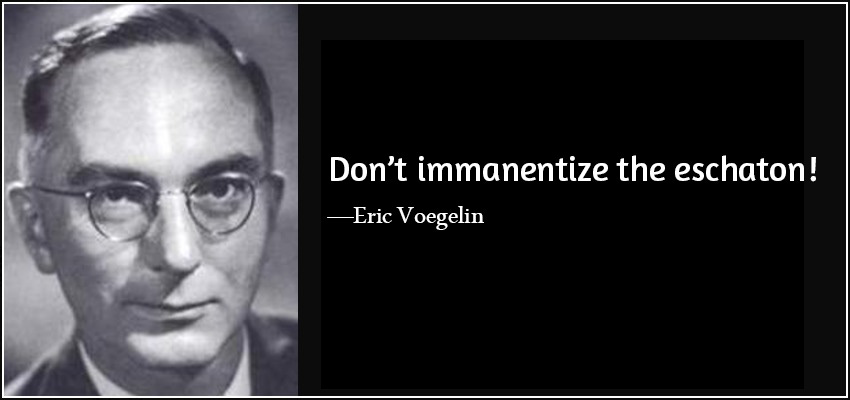
Eric Voegelin was a German-American philosopher who barely escaped the Nazis when they occupied Austria in 1938. One of his chief interests was in how symbols can be altered over time, reinventing their meaning. According to Voegelin, when the symbolism of a society collapses it can create whole new “Second Realities” which compete with the objective world, increasing societal disorder.
The Second Realities which cause the breakdown of rational discourse are a comparatively recent phenomenon. They have grown during the modern centuries, roughly since 1500, until they have reached, in our own time, the proportions of a social and political force which in more gloomy moments may look strong enough to extinguish our civilization—unless, of course, you are an ideologist yourself and identify civilization with the victory of Second Reality.
—Eric Voegelin, On Debate and Existence (1959)
Voegelin criticized what he referred to as the gnosticism of modern societies, which he was deeply concerned would lead to a collapse of symbolic integrity and meaning.
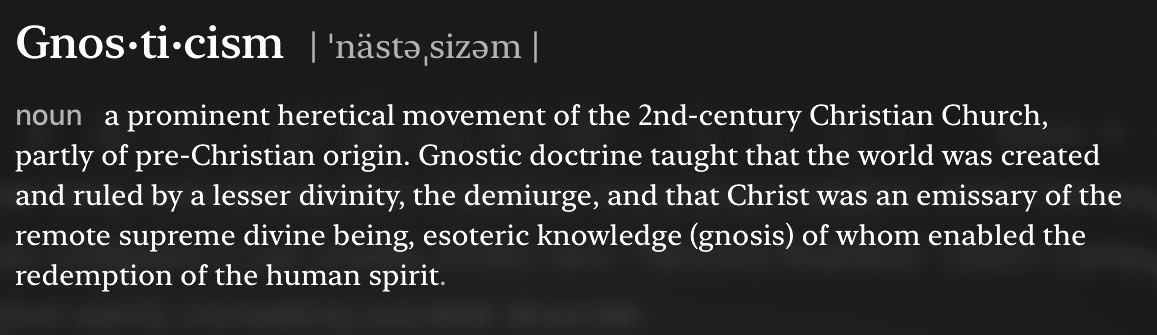
Perhaps Voegelin’s most famous phrase is: “Don’t immanentize the eschaton!” This means in basic terms that you shouldn’t try to make the end of the world (the eschaton) concrete (immanent). This slogan was used by people like William Buckley to make political points for many years, but Voegelin meant something deeper. He meant you shouldn’t try to find spiritual transcendence inside the bounds of history.
Voegelin believed that the consistent rise in societal disorder and violence over centuries is the result of Second Realities created by the collapse of symbols and therefore meaning. He identified “around 1500” to be the time that this symbolic decline began—without identifying the cause.
Technology As Accelerant For Symbolic Collapse
As someone who has both participated in developing technology for over three decades and extensively studied its history, I would argue the sudden jump in symbolic collapse and societal disorder Voegelin saw was accelerated by the printing press being invented decades before, around 1440 AD. This phenomenon also points to an important principle, and provides crucial lessons for the current moment.
Gutenberg’s invention was not an incremental step in civilization. The printing press suddenly enabled ideas, along with their symbolic representatives, to be circulated far and wide. This meant that every symbol—be it about church, state, family or society—had competition that it didn’t have before—competition the people who thought they owned the symbols never imagined. Suddenly people could debate the meaning of God over long distances, or criticize institutions and symbols that had never been questioned.
The printing press, by its very essence, had the power to accelerate symbolic collapse in ways that nation-states and cultures had never experienced. The same can now be said of an equally disruptive technology—the internet, including AI.
Humanity is a system like any other; it will always try to find an equilibrium between order and disorder. Just as 15th century nations and religions had never dealt with the kind of challenge to the symbolic order the printed word presented, 21st century institutions have not dealt with the internet and the explosion of AI.
The world has always had periods of relative order versus disorder: waves of violence, followed by reconstruction, leading to relative periods of peace which become destabilized over time. But as Voegelin points out, the amplitude of those waves seems to be increasing to the point that it risks “extinguishing our civilization.”
“The truth of order has to be gained and regained in the perpetual struggle against
the fall from it; and the movement toward truth starts from a man’s awareness of his existence in untruth. The diagnostic and therapeutic functions are inseparable in philosophy as a form of existence.”
Eric Voegelin, Order and History, Volume V
Symbolicide
Donald Trump and the PayPal Mafia billionaires that helped create him are engaging in what Voegelin might have seen as mass symbolicide: the wholesale destruction or reassignment of symbols in a society. As Voegelin spent his life explaining, this is not a new phenomenon. But the internet, and now generative AI, have made this kind of cultural and psychological violence far easier to execute, and visible to the naked eye.
The list of symbols that the Trump regime has either tried to destroy, or completely invert, is seemingly endless. Here are a few examples:
The White House is no longer the “People’s House,” it is a gilded Mar-a-lago. The Rose Garden and the East Wing are destroyed. Giant 88-foot flagpoles tower over the lawn. Gold paint is slathered everywhere. The symbol has been permanently damaged, at best.
The symbolic meaning of entire branches of government has been inverted. The Justice Department provides the opposite. The Civil Rights Division now protects criminals and elites. The Defense Department is now the Department of War.
The Bible has been converted to a branded marketing device, altered and reimagined in countless ways, from Trump’s own branded version for $60, to Pete Hegseth’s crusader edition with “Deus Vult” on the cover.
Jesus is not the Son of God, he is the Son of Fred. A decade of religious infiltration and corruption has allowed the least godly man in the world to claim divinity. The Pope is not the Vicar of Christ, he is a political opponent to be dominated.
The Capitol is not the voice of the people and the bulwark of democracy; it is a target—a hive of villainy and corruption that deserves violence. Trump’s pardoning of the domestic terrorists that tried to murder our representatives on January 6th was the symbolic capture of one of the most enduring symbols of the American Experiment.
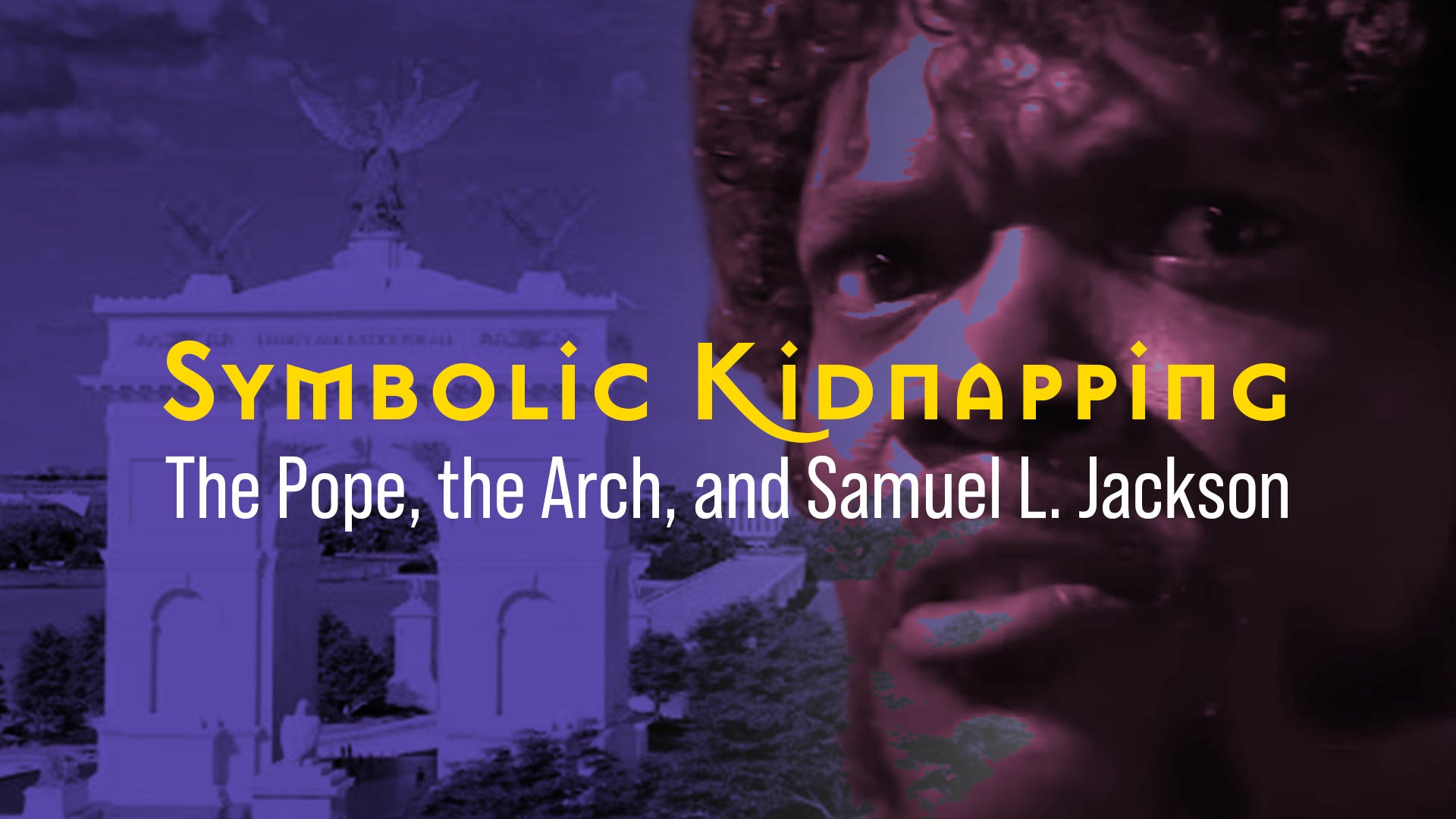
The list could go on but there may be no easier example to see than Trump’s proposed 250-foot “triumphal arch” in Washington DC. For comparison, the Lincoln Memorial is just 99 feet tall. Trump’s arch is not a “triumph” for America, it is a triumph of symbolicide. It is the semiotic sabotage of American history.
When Trump was asked what his 250ft arch in DC will celebrate, Trump pointed to himself and answered:
“Me.”

Reconstruction and Equilibrium
Just as institutions and nations were unable to easily compensate for challenges to their symbolic sovereignty created by the printing press centuries ago, modern societies are under symbolic assault because of the internet. Old systems that have not reimagined themselves to operate at the frequency of modern communications are structurally vulnerable to capture.
When the American justice system is still working under pre-internet rules, for example, it becomes vulnerable to challenges which operate on a frequency far higher than itself. When the symbols of justice (“Department of Justice,” “Rule of Law,” “Supreme Court”) can be captured, the purpose of the systems they represent can be captured as well.
The same warning applies for any institution. Symbols are not eternal. Symbolism can be kidnapped, inverted, and destroyed. Any system which cannot handle symbolic competition will end up dissolved and reconstituted.
But just as books destabilized the world, they also allowed it to grow far beyond anything that could have been imagined in the Middle Ages. Technology always forces old systems to grow to accommodate new challenges, or die failing to do so. We are now in the sorting phase of a new technological challenge to the symbolic order of the world. We are finding out what symbols can withstand the challenges presented by the digital world, and which are doomed to become discarded shells.
“America” is one such symbol. It is facing the biggest challenge to its meaning since its founding. It no longer represents life, liberty, and the pursuit of happiness. Every component of its promise has been reversed. The symbolic kidnapping is complete. But the question remains, will the kidnapper be able to murder his hostage?
We are the hostage. Our move.
If you haven’t upgraded to a paid subscription, please consider it! I never hide important information behind a paywall, so I rely on my readers for support. Thank you for reading and sharing!
If you’d like to help me with expenses, here is my DonorBox. 💙
Here are a few benefits to upgrading:
Live Zoom call each Sunday
Ability to comment and access all content
Wonderful, supportive community
Helping independent journalism fill in the gaps for our failing media
If you’d like to help with my legal fees: DefendSpeechNow.org.
My podcast is @radicalizedpod & YouTube — Livestream is Fridays at 3PM PT.
Bluesky 🦋: jim-stewartson
Threads: jimstewartson
My inbox is swamped, so in deciding which email to open next I picked yours because your posts are usually short, sweet, and to the point. So much for that. There's a lot here to unpack. The 160 other emails I intended to get to can wait.
I do have a minor quibble in that I think you've lumped the voice of God in the movie version of the verse with the wrong version. As I see it, the hitman character is placing himself in the position of God, so his speech is more properly lumped with Hegseth's prayer as an act of self promotion. Along the lines of Trump's AI Jesus impersonation.
The shattering of our symbology is not a fait accompli. We are disoriented by its violence, but it remains to be seen how robust it is within a critical sector of our society. The independent media are doing their best to hold things together. Thanks, Jim, for helping to hold things together.
Think of the money we will raise tearing down and destroying the arch 😁