

“It’s not books you need, it’s some of the things that once were in books.”
—Ray Bradbury, Fahrenheit 451
“The purpose of a system is what it does” is a concept originating in cybernetics and management theory as a way to diagnose problems in a system. While it sounds kind of obvious, it’s really not. The phrase is meant to explicitly omit whatever the intent may have been in designing the system.
So instead of asking “what is the system supposed to do?” you ask “what does it actually do?”—before anything else. This has come to be shortened to POSIWID, and remains a well-used heuristic.
This concept is important in analyzing the AI industry because we are being sold one system, while a completely different system is gobbling up the economy.
As an example of the industry’s narrative, OpenAI CEO Sam Altman did an interview with Politico following Trump pushing for unregulated growth of “Super Intelligence.”
“We’re gonna, like, make our products safe… [but] the world should accept some bad things happening. Because there will be tremendously, orders of magnitude, more good stuff than bad stuff.”
There is a lot you could say about Sam Altman, including the horrific allegations by his sister, the fact that he met his husband in Peter Thiel’s hot tub, and that his company is embroiled in the cult of Effective Altruism. But it’s not that he’s a grimy person which is of interest here; it’s that he says his AI company is worth upwards of $1.5 trillion.
Is it really?
After 20 minutes of wrestling with Sam Altman’s chatbot, I was able to get it to produce an infographic of the system that Sam Altman wants us to believe in. He and his fellow AI promoters want us to think the massive investment in data centers is “infrastructure” for producing “AGI,” brand new scientific discoveries, and even “abundance.”
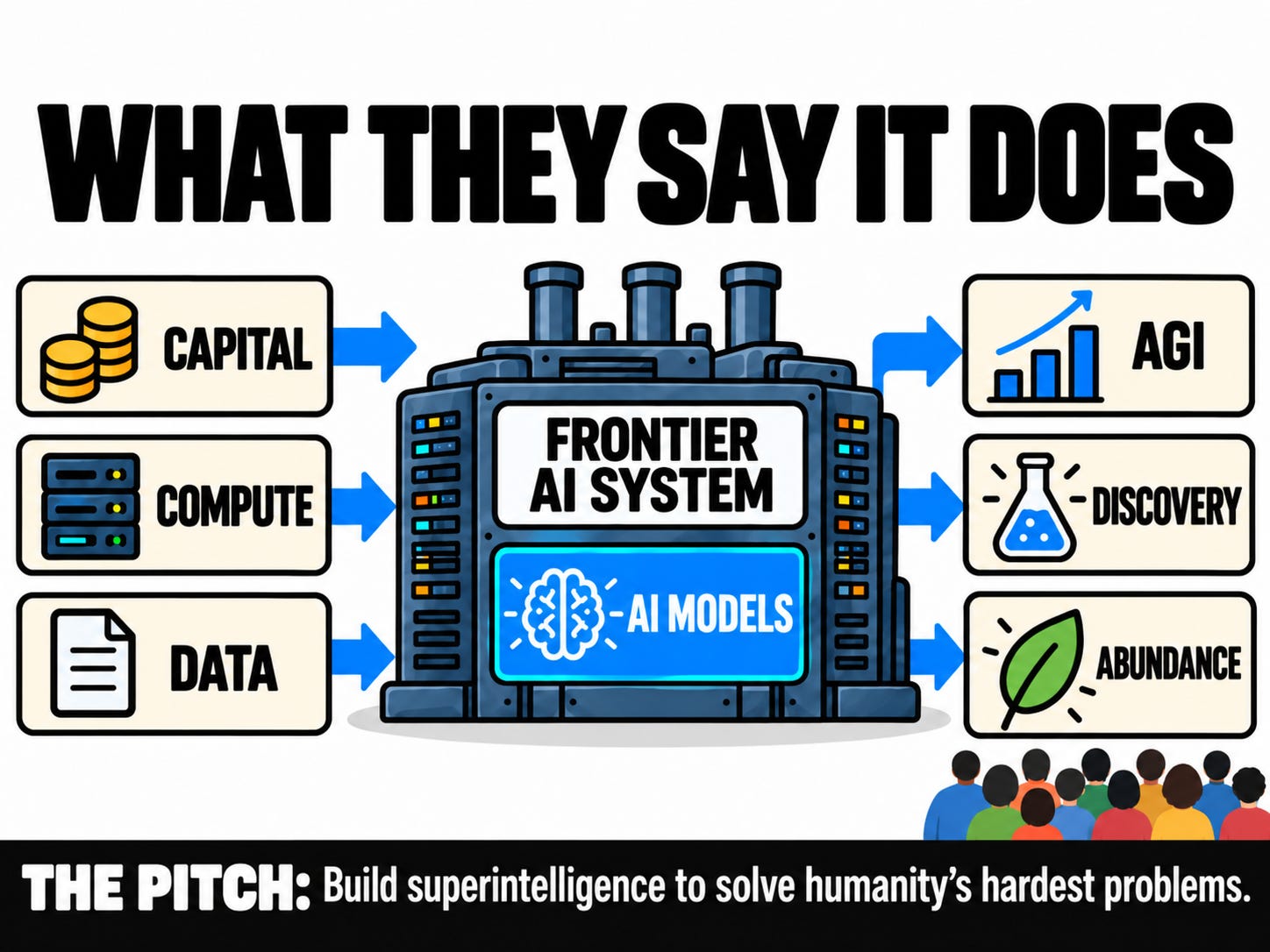
Big if true! Just put money and all the data from the internet into a giant computer, and the intelligence will come flowing out!
But if the purpose of a system is what it does, a far different picture emerges. It is not a magical intelligence machine, it is an extraction device. After another session of coaching, Sam Altman’s chatbot gave me the following diagram of the actual system that he’s helped to create.
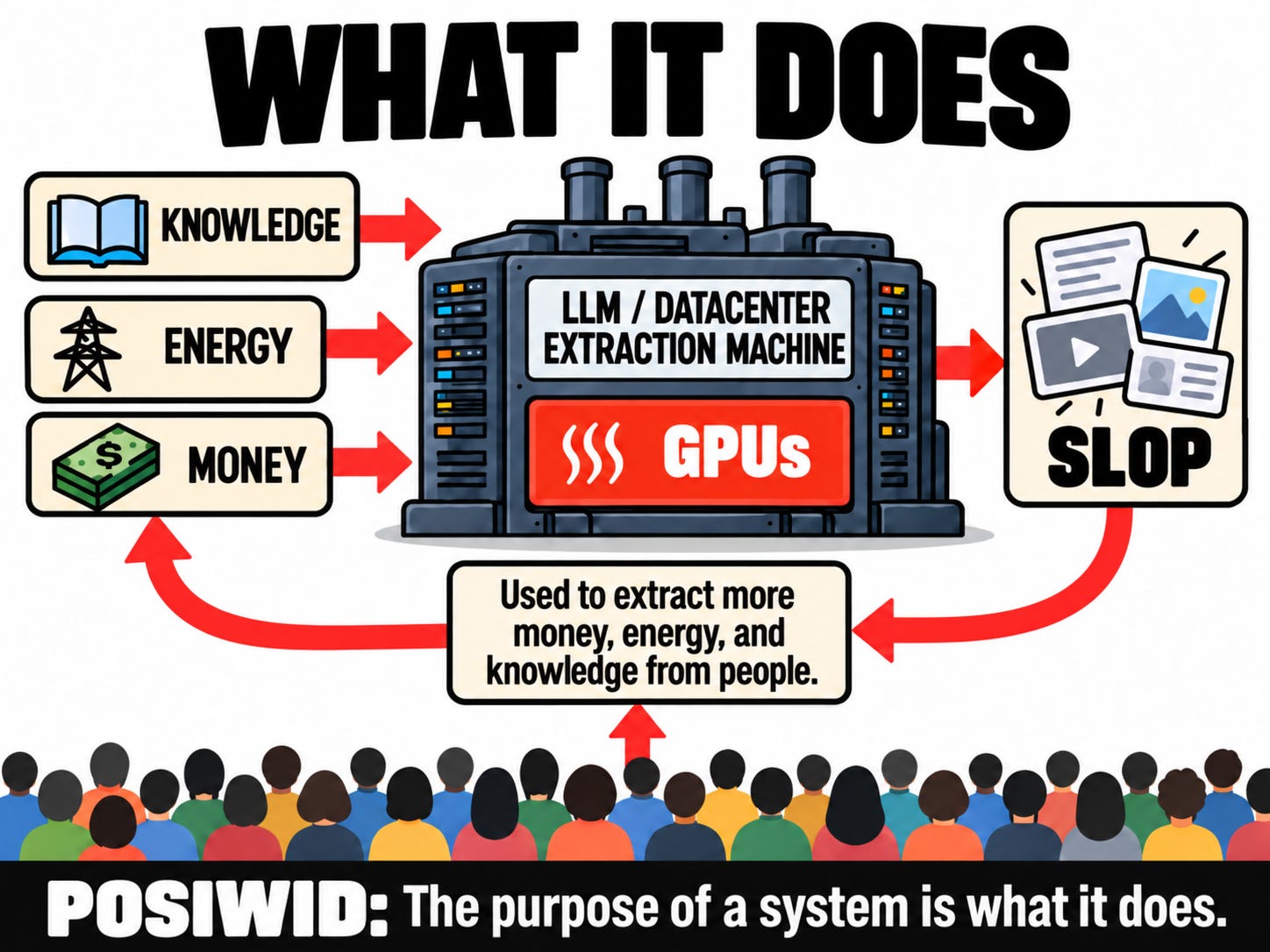
Hundreds of billions have already been spent to create the biggest supercomputers ever seen. Trillions more have been promised to continue to scale them up—all based on promises that suddenly they will sprout “AGI” and make everything better.
This is the reality:
The AI industry is a system for extracting money, energy, and knowledge from the population, ad infinitum.
The promise that chatbots will suddenly become intelligent if you just make them bigger is a very powerful self-reinforcing delusion that has dug a $10 trillion ditch in the economy.
For example, the only company with an even more bizarre story than OpenAI has trained its chatbot from the very beginning with a long script about how it’s actually an “entity” with “emotional states” and “moral standing.”
In other words, Anthropic trains “Claude” to respond like a person and then points at the response to claim that it’s more like a person. For instance, “Claude’s Constitution” is part of its training and frankly it’s one of the most profoundly stupid documents I’ve ever seen.
I angrily scribbled on things that are patently idiotic on just two pages, including the repetitive refrain that “we don’t understand” how a chatbot works, and that it might have “perceptions,” and “identity.”


Pure gobbledygook from people who have no understanding of computer science.
If you simulate a hurricane in a computer, you do not get a hurricane. If you simulate emotions in a computer, you do not get emotions. It’s really that straightforward. This doesn’t mean the simulation isn’t useful, but a simulation is not its own subject by definition.
Also, we absolutely do understand how chatbots work. This aggressive ignorance hides the story they don’t want people to hear: data centers and the AI industry provide nothing that we can’t have without trillions in capital expenditures for “frontier labs.”
AI is the greatest misallocation of resources in all of human history.
To see the true misanthropic goals of the industry, the richest man in the world freely promotes the “success condition” of human beings as a “biological bootloader for digital superintelligence”—a euphemism for becoming extinct. Simultaneously, Musk agrees that America should only be ruled over by “high T alpha males” and “autists.”
“Women and low T men” need not apply to this version of “democracy.”


So put together, we have a massive extraction system which is funneling our money, energy, and knowledge to a tiny group of people who consider themselves “high T alpha males.” We are collectively surrendering to overgrown adolescents who believe they are the only ones to rule the world—and also that evil is “kind of good.”

In Fahrenheit 451, published in 1953, Ray Bradbury told of a world where humanity had given up on new ideas, choosing instead to recycle the things it had already done. Ideas that had not been homogenized and approved were to be eliminated as dangerous.
“A book is a loaded gun in the house next door. Burn it. Take the shot from the weapon. Breach man’s mind. Who knows who might be the target of the well-read man?“
But the reality was that it was not the new ideas that were dangerous. It was the lack of them.
“We are living in a time when flowers are trying to live on flowers, instead of growing on good rain and black loam… Yet somehow we think we can grow, feeding on flowers and fireworks, without completing the cycle back to reality.”
The soil of our collective intelligence is being depleted through extraction by a machine fueled by our own money and resources. It is a doomsday device feeding on our minds and selling them back to us as slop.
“It took some man a lifetime maybe to put some of his thoughts down, looking around at the world and life, and then I came along in two minutes and boom! it's all over.”
—Ray Bradbury, Fahrenheit 451
If you’d prefer to donate, here is my DonorBox. 💙
Here is a GoFundMe for legal fees connected to Mike Flynn and Kash Patel’s lawsuits.🙏
I think on your graphic it's not helpful to refer to AI output as "slop." Some output might be of low value, but a lot of people are getting a lot of value out of their AI subscriptions.
It's a separate issue whether or not Sam Altman is a bad guy or friends with Peter Thiel.