

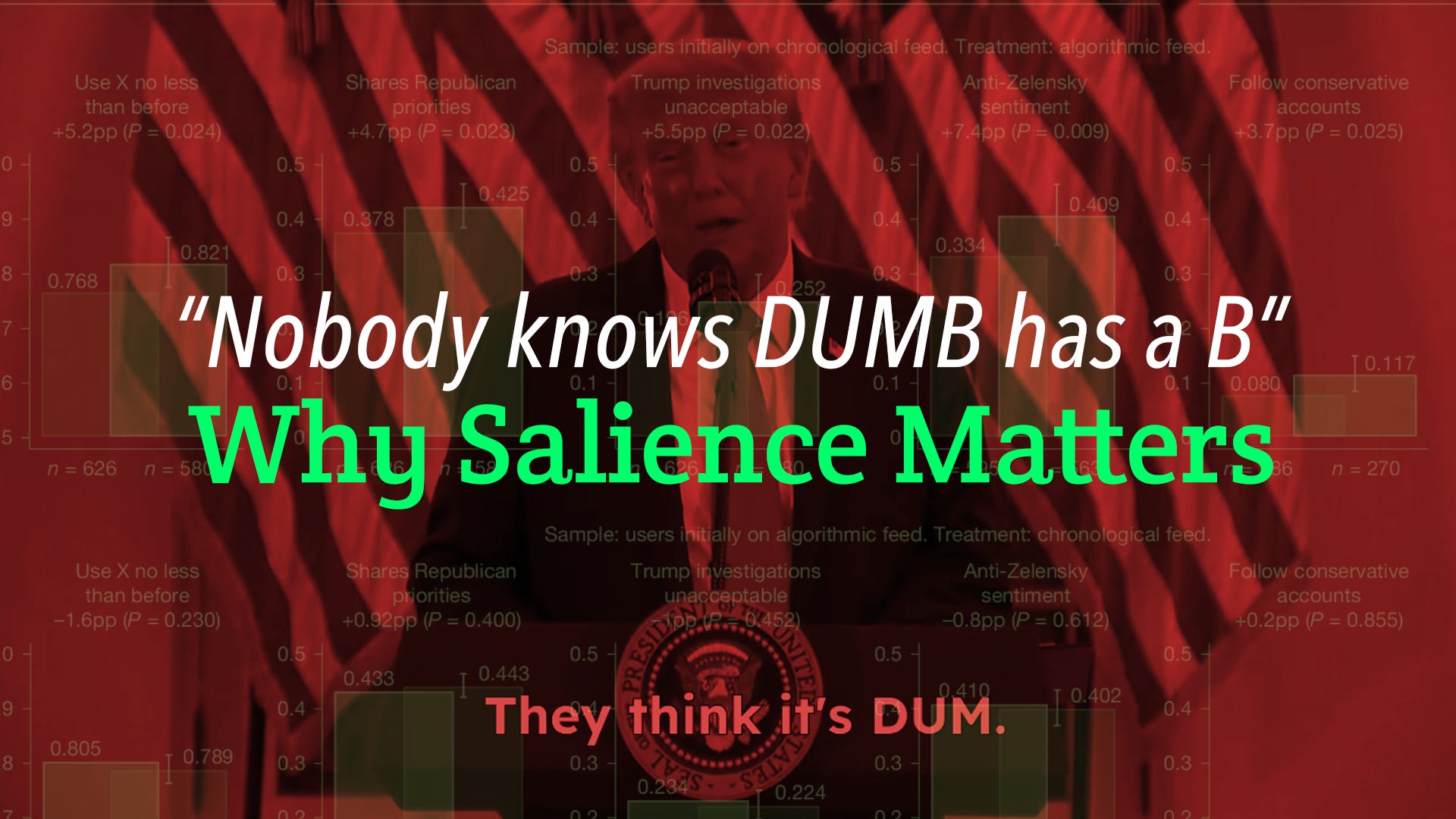
As a close observer of Donald Trump, one of his most consistent stories over the last several months is also one of the strangest. He delivered it once again Wednesday night at a dinner for GOP candidates in swing states.
“And then I said, well, if you replace the E with the U, instead of Democrat, you have Dumocrat. And most people don’t know that dumb has a B at the end. They think it’s DUM. And that’s OK. So it’s a one letter change. And you go, no more E, you just put a D, and you got a Democrat. And that’s because their policy’s so bad.”
—Donald Trump, President of the United States
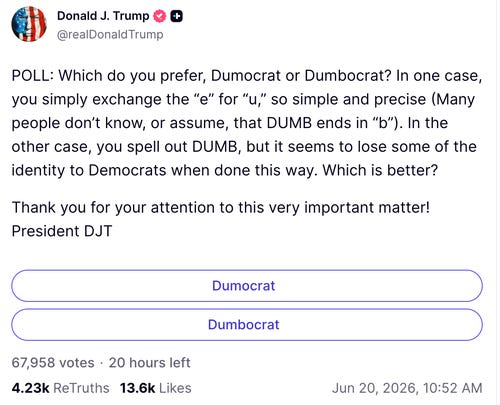
This behavior has gone on since May. In June, he created a “poll” on the subject which took as a parenthetical assumption “many people don’t know, or assume, that DUMB ends in ‘b’”—requiring anyone who responded to implicitly accept his delusions.
He also told the same story in Beijing, at an economic speech in New York—twice, at an agricultural roundtable in Chippewa, and at the White House Correspondents’ Dinner—plus at least a dozen more occasions.
In this article, I seek to explain why he said this in the first place, why he keeps repeating it, and why it matters to the rest of us.
It Matters Why It Matters
“My experience is what I agree to attend to.”
William James, The Principles of Psychology, 1890
Salience in conversational English means: the quality of something being particularly noticeable or important. In other words: how much something matters.
But salience also has a neurological meaning. A significant part of the brain is involved in assigning salience to incoming information—usually with no active conscious input from the subject.
Salience network (SN): A large-scale network in the brain that helps detect which internal or external signals matter most, prioritizes them for attention, and helps switch between inward-focused thought and outward-focused executive action.


Your salience network (SN) is always at work, constantly sorting through your sensory input and your internal thoughts to determine what rises to your conscious attention, what requires an instinctual emergency reaction, and what should be quietly integrated into storage or overlooked. However, the impact of the SN is not just procedural, because in many ways it determines how you actually perceive the world.
Think of every person as having a salience map laid over their input that determines which things are elevated to the conscious mind and under what category, and which are not. In this way, the SN literally curates how every human experiences the world differently—based on what they have already learned and encoded as an individual.
A hunter, for example, may have a very different reaction to a gunshot than a victim of violence. Salience also helps explain how your brain uses the “cocktail party effect”—where your auditory system can pick up your name through a crowded field of stimuli without you even consciously listening—and give it priority attention. And salience gives you that sudden jolt of recognition that foregrounds the solution to a problem after thinking through many possibilities.
Repeat After Me
The salience map—the set of rules for triaging sensory or internal input—is not static. It constantly adjusts based on new information generated on the inside and from the outside.
One way salience can be externally affected is through repetition.
It is a long-established in cognitive science that repeated exposure to a specific stimulus will increase how much something is liked, but that effect has now been experimentally tied directly to salience. Repetition also increases emotional intensity, and how extreme something is evaluated.
The impact of repetition on salience has broad implications for disinformation and undue influence (“brainwashing”) in a digital environment increasingly devoted to maximizing exposure through algorithmic and generative technologies. It also provides a neurological mechanism for the psychological symptoms we’ve seen in so many who’ve fallen prey to insulated political cults like MAGA, QAnon, and others.
To change someone’s opinion, you don’t have to challenge their beliefs directly. If you can alter what they’re exposed to, and how often, you can change what gets their attention in the future—and what doesn’t.
In the Wild
“repeated exposure to stimuli influences evaluations by increasing salience, the relative quality of standing out from other competing stimuli.”
—Kellen Mrkva & Leaf Van Boven, 2020, “Salience Theory of Mere Exposure”
It has already been shown that on platforms like X (Twitter), the impact of the algorithm on the “For You” screen can have a significant impact on affective (emotional) polarization towards the perceived opposition.

A newer study published in February’s Nature, however, provides significant evidence that switching from a chronological feed on X to the “For You” algorithm can change political opinions, while switching to chronological feed from the “For You” feed does not.
Seven weeks of X’s algorithmic feed:
shifted several political attitudes in a conservative direction;
altered issue priorities (Trump’s prosecution unacceptable, anti-Zelenskyy sentiment, share Republican priorities);
increased following of conservative activist accounts;
reduced exposure to traditional news organizations by about 58%;
increased political-activist content about 27%;
showed posts carrying vastly greater engagement/social proof than chronological feeds.
After exposure, users’ chronological feeds themselves contained about 60% more posts from conservative accounts and 28% more from conservative activists because users had changed whom they followed.
The political effects of X’s feed algorithm (Nature)


Elon Musk has the power to alter the salience map—and therefore the perceived reality—of hundreds of millions of users simply by altering what they see and how often they see it on the “For You” feed. And as I warned months before he bought Twitter, he has been using that power to attack democracy. His motivations are clear.

Musk’s platform is an example of how the salience map of the population can be algorithmically altered from the outside, but it’s just as important to understand how it can be neurologically distorted from within.
Salience Distortion
Abnormalities in the salience network have been observed in numerous psychiatric disorders including depression, anxiety disorders, post-traumatic stress disorder (PTSD), schizophrenia, Lewy-body dementia, and Alzheimer's disease. These changes are especially notable in behavioral frontotemporal dementia (bvFTD), a condition with symptoms that perfectly match President Donald J. Trump.

Characteristic behavioral symptoms of bvFTD include:
disinhibition—the tendency to be inappropriate around others;
apathy—not just being tired and lazy, but just not caring;
diminished empathy;
compulsive/repetitive behavior;
perseveration.
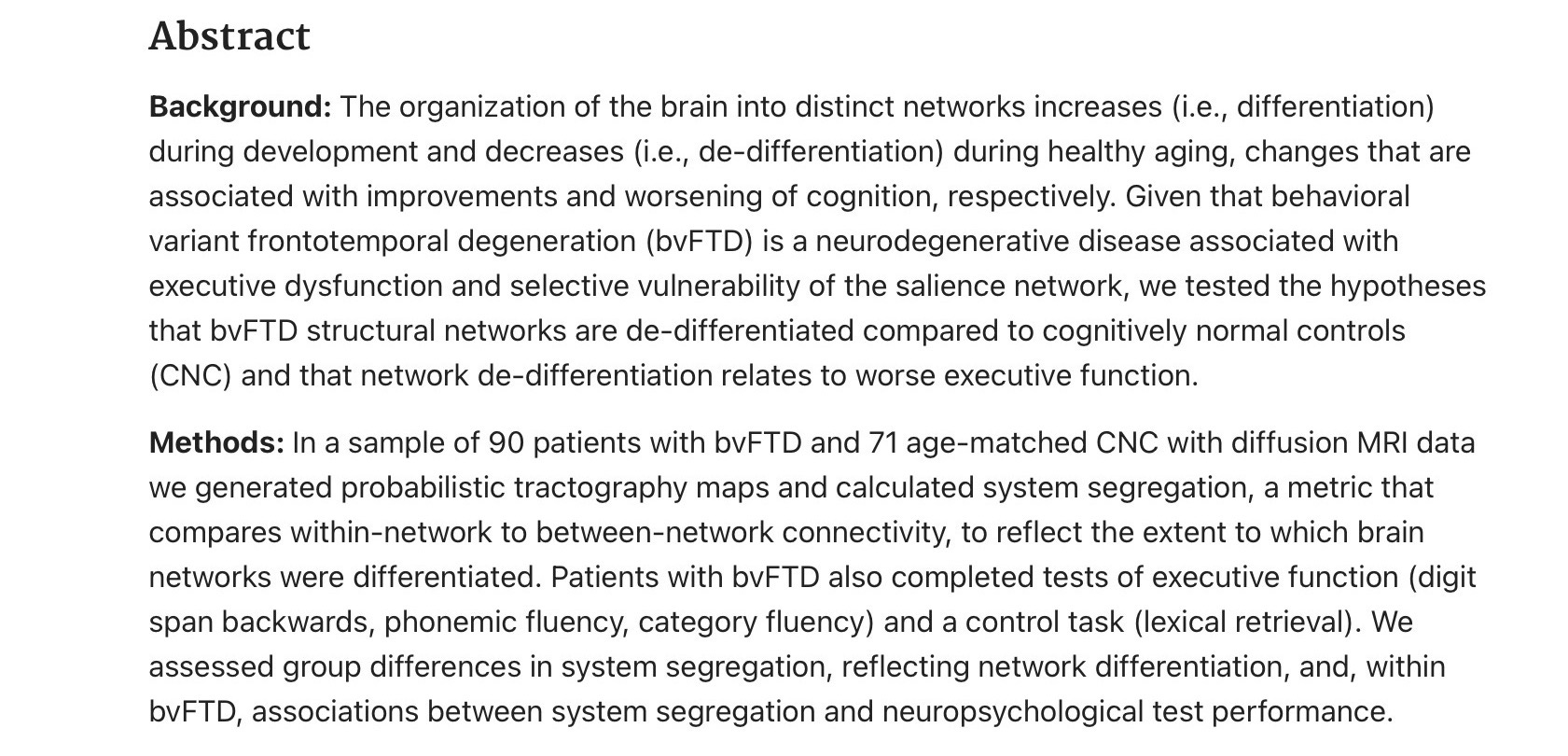
In 2010, William Seeley found that bvFTD is a “breakdown in the Salience Network.” And in 2025, it was reported that executive dysfunction in bvFTD patients—impaired planning, inhibition, cognitive flexibility, working memory, sequencing and goal-directed control—relates to the salience network being “desegregated.” The salience network itself becomes less and less differentiated from the rest of the brain. The more this desegregation occurs, the worse the patients do on executive function.
While it is impossible to diagnose Trump without an MRI and testing, every major symptom of bvFTD is observable in the president. When he rants for ten minutes about alleged vandalism in the Reflecting Pool, it’s not just Trump being Trump; he has lost the ability to make judgements and decisions—and crucially, to know what matters at all.
“Nobody knows DUMB has a B”
Returning to Trump’s story about the etymology of “Dumocrats,” it is obvious that his personal priorities are wildly distorted. For a president to conjure up juvenile epithets for his political opponents is one thing, but to obsessively retell a false narrative about it in inappropriate situations is another.
So why this story? Why does Trump’s salience map choose to elevate this strange anecdote?
The psychological motivation for the story is clearly the same as nearly everything Trump does, to repair a narcissistic injury—a wound to his messianic ego—by elevating himself above others.
The injury appears to have occurred when he came up with “Dumocrats” in May and someone pointed out that it has a B—which he himself did not know. He was so wounded by this humiliation that he created, through sheer repetition, an alternate reality, a psychosis, in which “nobody knows dumb has a B.”

A younger version of Donald Trump might have moved on from the nickname, or even told the story once, but for this version of Trump, it’s impossible to separate the word “Democrats” from the injury he received when he tried to make fun of them.
Trump’s dissolving salience network has kept this trivial event near the top of his mind for months. He can no longer tell what matters and what doesn’t—which means his reality is distorted by the things that get his personal attention, like a massive triumphal arch, despite a lack of triumphs.


Natalie and the Perfect Storm
Having a person with Donald Trump’s psychopathologies and neurodegenerative disorders in the presidency is dangerous enough, were checks and balances in the government working and were he surrounded by people who still wanted to make America work. But that is not the case at all.
Instead, the Republican Party has abdicated all power to a dysfunctional octegenarian who has surrounded himself with people like Natalie Harp, who largely serves as his interface to the world. She is a human salience map, who only tells him what he wants to hear. She decides what matters—and she helps decide what to do about it.

This creates a science fiction-like scenario in which the Commander-In-Chief of the U.S. Armed Forces is totally untethered to the objective world or the population. Instead, Trump has built a system which replaces his desegregating salience network, to tell what him matters. He instructs people like Natalie Harp what merits his attention—and then they reinforce it.
“You are all that matters to me. I don’t want to ever let you down.”
—Natalie Harp
This is a perfect storm of salience distortion because Trump himself has seized the power to determine much of what matters to the world. He repeats his delusions, whether it’s “nobody knows DUMB has a B” or “the Strait of Hormuz is open,” and as a result he alters the salience map of his followers—including many in the federal government. His delusions tell them what matters, and they repeat it.
“The narcissistic fiction is confirmed by consensus or by reality. This is the true folie à million.”
—Erich Fromm, 1963
Trump’s narcissistic fiction is the story he’s forcing his world to swallow which, like a mother bird, regurgitates it back.
Protect Your Salience Network
Most of us, fortunately, do not have or require a Natalie Harp, or an army of sycophants to tell us what matters. We have to rely on our own salience maps, as interpreted by our brains’ salience networks, to determine what merits our attention and what does not. As I’ve written, just knowing how these things operate makes them less powerful, and far less likely to pull you down a harmful rabbithole.

While there is no way to predict what will come next from Donald Trump, or the government he has demented to mirror himself, we can be guaranteed that it will get worse. The midterm election season will be a brutal exercise in trying to figure out what’s real and what isn’t, and what matters and what doesn’t. The salience distortion will be off the charts.
Your job, dear reader, is to make sure you focus on what matters to you—not to those who would try to influence you by distorting your salience map.
“The faculty of voluntarily bringing back a wandering attention, over and over again, is the very root of judgment, character, and will.”
—William James, The Principles of Psychology, 1890
Thanks again to all who have sent messages, subscribed and donated recently in light of the judge’s ruling in the Flynn case. It is deeply appreciated.
NOTE: My articles are extensively researched and written by a human—me. No chatbots touched the words on this page.
Here is my DonorBox. 💙
Here is a GoFundMe for legal fees.🙏
Those of us who read phonetically think Dumbocrats has something to do with an elephant.
Fabulous analysis, thanks. Trump's brain is fried. He was always a dumbass, but now he appears batshit crazy. That is my nontechnical diagnosis. Yours is much better, clearly.